Léon Gambetta
Also known as: Léon Gambetta, Leon Gambetta, M. Gambetta, M Gambetta, Gambetta, Léon le Dictateur, le gros Président
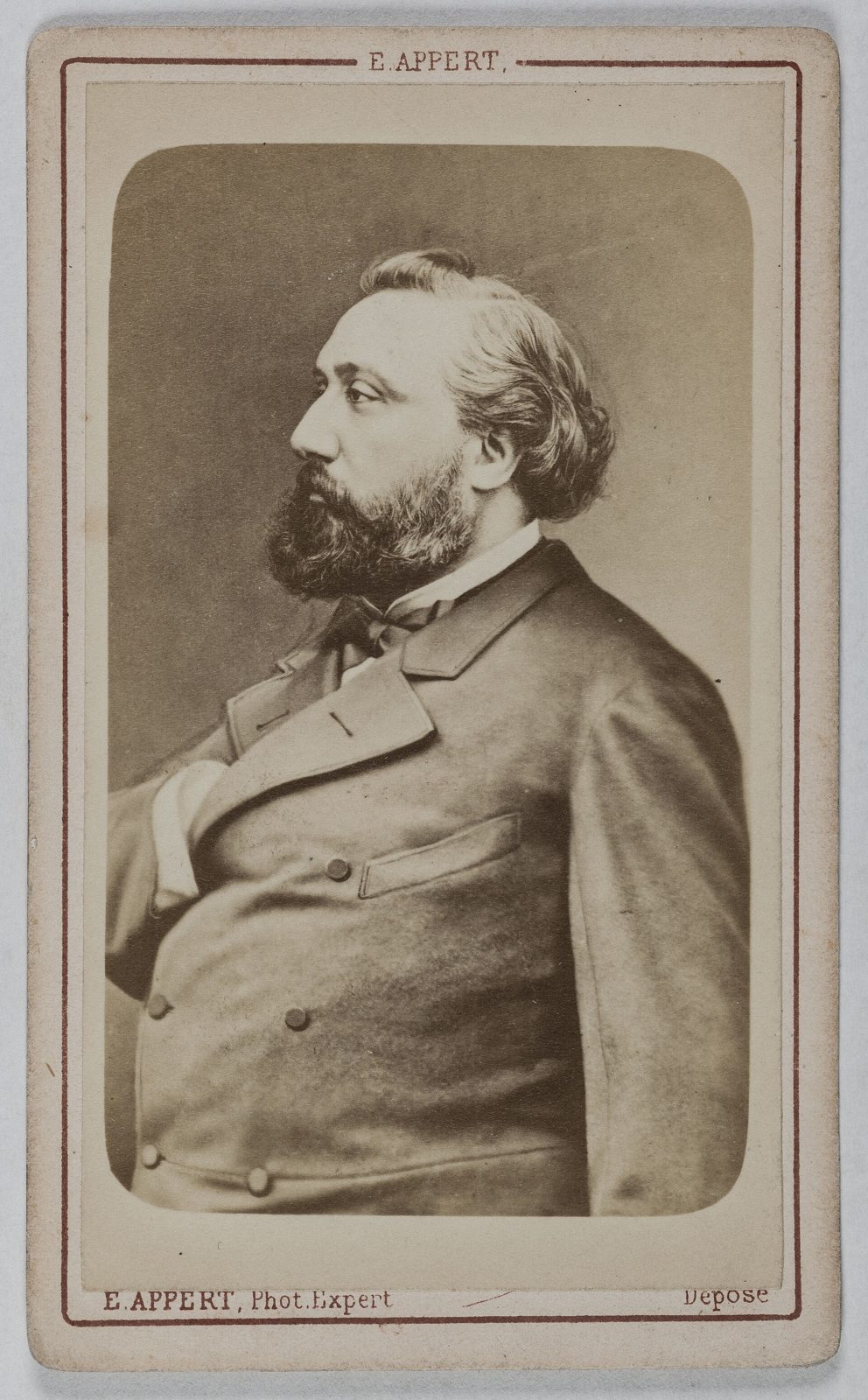
Léon Gambetta
Who he was
Léon Gambetta (2 April 1838, Cahors -- 31 December 1882, Les Jardies, Sèvres) was the dominant republican politician of the early Third Republic. He was the son of Joseph Nicolas Gambetta, a Cahors shopkeeper of Genoese origin, and lost the use of his right eye at the age of eleven, when a fragment of a steel rod struck it in a cutler's workshop (summer 1849) (Wikipedia fr, "Léon Gambetta"). He became a republican barrister under the Second Empire, proclaimed the Republic in Paris on 4 September 1870, and on 7 October 1870 left the besieged capital by balloon to organise the war effort in the provinces. After the peace he led the republican majority against the "Moral Order" governments, and the republican victory of 1876--1879 (including the resignation of MacMahon in January 1879) made him the most powerful man in France without holding the highest offices.
He was President of the Chamber of Deputies from 31 January 1879 to 27 October 1881 and then President of the Council of Ministers (prime minister, with the Foreign Affairs portfolio) from 14 November 1881 to 30 January 1882, the so-called "Grand Ministère", which fell after seventy-three days over the reform of the electoral system (scrutin de liste) (Wikipedia fr). He then returned to the ranks as an ordinary deputy. From 1872 his companion was Léonie Léon; in 1878 he bought Les Jardies, Balzac's former house at Ville-d'Avray/Sèvres. He died there on 31 December 1882, aged forty-four, a few weeks after being wounded by a revolver shot at the house; the circumstances of that accident are still told in different ways, and Marie herself reports only that he was "malade, ou blessé" (097.0328) and that she was shown the bullet hole in the wall (098.0074). The funeral on 6 January 1883 was the first state funeral of the Republic (Marie's account: 097.0369--0377); he is buried in Nice, and his heart was moved to the Panthéon in 1920 (Wikipedia fr).
Marie and Gambetta
Marie never met Gambetta. She looked for years for an introduction and complained in 1880 that she must give up "toute idée de connaître Gambetta et de faire son portrait" (090.0175); after his death she wrote that she did not know what she would have become "si j'avais eu le bonheur de connaître cet homme" (097.0403). What the diary records is a long one-sided relationship of three phases: hostile political reflex (1873--1877), erotic and ambitious fantasy (1878--1881), and mourning (1883).
1873--1877: the enemy of the Bonapartist and legitimist household
His name is in the diary from the first year, as a stage figure: at the Folies Marie sees the mimic Plessis impersonate "Guillaume, Gambetta, Napoléon 1er et Garibaldi" (006.0199, 7 July 1873). Her family's politics make him a villain. In 1876 she calls the Republic worthless ("ni dans un pays ni dans une maison", 034.0572), says that after the Orleans princes the throne would pass "après Gambetta" and that only the Empire is left for honest people (064.0045), and on 10 September 1876, hearing a guest predict a presidency for him, swears to be "une seconde Charlotte Corday" (066.0158; again 066.0590). She nevertheless writes to him (066.0608, 3 October 1876) and in January 1877, learning that he is in Nice, sends him a letter that she hopes will bring him to her (068.0443, 068.0478). Her description of him on 26 November 1876, watching a Chamber debate, is typical: "une figure ignoble et repoussante ... l'illustre faquin, le célèbre épicier" (067.1248).
1878--1881: marriage fantasies
On 18 April 1878, while she is still in love with Paul de Cassagnac, she resolves to meet the republican leader, partly "pour faire quelque chose de désagréable à Cassagnac" (079.0454--0455). In May and June 1878 the idea becomes a running joke and a half-serious plan: she tells Mme Baudouin she will marry him (080.0025), threatens her Russian circle with it (080.0079), imagines Dina and herself marrying "Popaul et Gambetta" (080.0152), reads a rumour that he is about to marry (080.0247, 21 May 1878) and weighs his income against his looks in her diary (080.0398--0400, 081.0386--0387: "il est trop laid et trop gras et il a l'air sale"). On 16 June 1878 his carriage stands beside hers near the Arc de Triomphe and Gavini, a Bonapartist deputy, promises to introduce her (080.0628).
She tries to approach him through tickets. In November 1878 Mlle Oelsnitz is sent to him with a letter from Princess Eristoff; he supplies two tickets for the Versailles sitting and promises a visit to the princess (083.0111, 083.0126, 083.0134). From February 1879, when he became President of the Chamber, she studies him from the gallery, asks him for a permanent card (084.0208) and notes that he reads his inaugural address "mal ... d'une voix détestable" (084.0171). On 1 April 1879 she tells the atelier, as an April fool, that someone has fired at Gambetta (084.0587). In July she writes to the Princess to "me conduire chez Léon" when he gives a party (085.0526).
On 16 June 1879 she is in his box at the Chamber when he excludes Cassagnac in a violent sitting and comes away with an "impression affreuse" of his "attitude d'ivrogne" (085.0328--0365). A few months later the verdict reverses: after hearing from the financier Hecht, who claimed to have known Gambetta for ten years, she writes that Gambetta "n'est pas un vulgaire ambitieux" and admires him sincerely (086.0179, 086.0194, 086.0216); on 9 September 1879 she enters her salon announcing herself as "la citoyenne Gambetta" (086.0241); on 11 October 1879 a fortune-teller predicts that she will marry an illustrious man of forty to fifty whose hair is turning white, and Marie thinks of Gambetta (086.0366). She repeats the idea in 1880: "Si Gambetta me demandait j'accepterais" (087.0348; also 087.0268, 087.0386). In Paris she follows his movements by sight: at the Chamber on 29 November 1879, where he looks at her through his opera glass (086.0602); at the Théâtre-Français on 17 November 1879 (086.0546); in the Bois (087.0331, 087.0525).
The most serious political reaction comes on 21 June 1880 with his amnesty speech: "après lui il n'y a plus personne" (089.0015); on 12 August 1880 she sends home the newspaper speeches of Gambetta as "très habile", an answer to the radicals and intransigents (089.0337). In October 1880 she sees him at the theatre, surrounded by Hecht and Joseph Arnaud, and gives up hope of an introduction (090.0174--0175). In January 1881 an acquaintance of the Moreau family tells her that Gambetta "ne refusait rien aux jeunes filles" and that a portrait sitting might be possible; Marie does not believe it and decides she is not ready (090.0515--0516). On 22 February 1881 his peroration "ce jusqu'à la mort" brings her to tears and makes Cassagnac look "pâle, misérable" (091.0175--0177). In May 1881 the press announces that he is to marry a Durand sister; Marie reports the rumour and its denial (091.0583, 091.0616).
1881--1882: premier and fall
She is anxious about his election in August 1881 ("Cet homme-là habituera une quantité de gens à la République", 093.0011) and notes that he was "élu très mal" (093.0013). On 7 November 1881 she finds him, back as a plain deputy, "superbe au physique" at his bench (093.0352); a week later she records that he has "pris le pouvoir" (093.0368). On 26 January 1882 she and her mother try to get into the "immense séance Gambetta" (094.0207); the next day she defends him: his fall was caused by the cowardice and bad faith of the intransigents (094.0210, 094.0212).
1883: death and mourning
The entry for 1 January 1883 opens with his death: "Je ne peux pas dire l'étrange effet produit par cette mort" (097.0328--0329). In the following week she writes some of the longest political passages of the diary: on the press's "mauvaise foi" (097.0330, 097.0377), on the seven physicians at his bed (097.0332), on the civil burial and the crowd (097.0356, 097.0369--0377), on Brisson's funeral speech and Hecht's phrase "nous sommes décapités" (097.0383), and on the lost possibility of a Franco-Russian alliance with Skobelev and Chanzy (097.0389--0390). She reads about him, Mirabeau and the Revolution for a week (097.0416) and sums up: "je suis désespérée de la mort de Gambetta" (097.0417). On 16 January 1883 Émile Bastien-Lepage takes her and Dina to the house at Ville-d'Avray where Jules Bastien-Lepage is painting the dead man's room: she describes the cramped bedroom, sketches its plan in the diary, sees the bullet hole and cries (098.0058--0080). After this she repeatedly measures later men against him: Clemenceau is "le seul après l'autre" (098.0140), a speech by Gambetta had made her forget Cassagnac (098.0150), and in November 1883 she lists him beside Napoleon, Alexander and Caesar as someone she has wept for (102.0347).
1884: the monument
In June 1884 Marie follows, through Émile Bastien-Lepage, the competition for a Gambetta monument: she hears that a decision on who will make it is expected on a Thursday (104.0501), visits the exhibition of the competition entries at the École des Beaux-Arts with Dina on 3 June 1884 (104.0502), and learns on 9 June that Émile was not among the six finalists; she judges his design "très froid ... pas en rapport avec la personnalité de Gambetta" (104.0556--0557). In July she scorns Bojidar for claiming that he knew Gambetta (105.0301). She still uses the dead man as a measure on 23 August 1884: "Et Gambetta était borgne mais c'était des hommes" (105.0656).
Correction to the earlier version of this entry
The previous text of this page said that Marie's interest began in October 1879 as a shift "from Bonapartism to Republicanism". The diary shows that she wrote about Gambetta from 1873, that her hostility lasted until 1878, and that her fantasy of marrying him dates from April--June 1878; her admiration was real in 1879--1881 but she did not become a republican in the party sense and wrote of the "gros Président" with irony until the end. The old text also stated that he was killed by a shot fired by his mistress; that is not supported by the sources consulted and has been removed.
Related entries
- #Cassagnac -- Bonapartist opponent; Marie's Cassagnac and Gambetta fantasies run in parallel
- #Bastien_Lepage -- painted Gambetta on his deathbed in January 1883
- #Politics -- the Third Republic and Marie's political world
- #Chambre_des_Deputes -- where she watched him
Sources
- Wikipedia (fr), "Léon Gambetta": https://fr.wikipedia.org/wiki/L%C3%A9on_Gambetta
- Marie Bashkirtseff's diary, paragraphs cited above.
Most of this glossary was researched with the help of AI language models and checked against the sources cited; mistakes are possible. If you spot one, please report it with the button at the top of the page.