Sarah Bernhardt
Také známý jako: Sarah Bernhardt, Bernhardt, Sarah Bernhard, Sarah
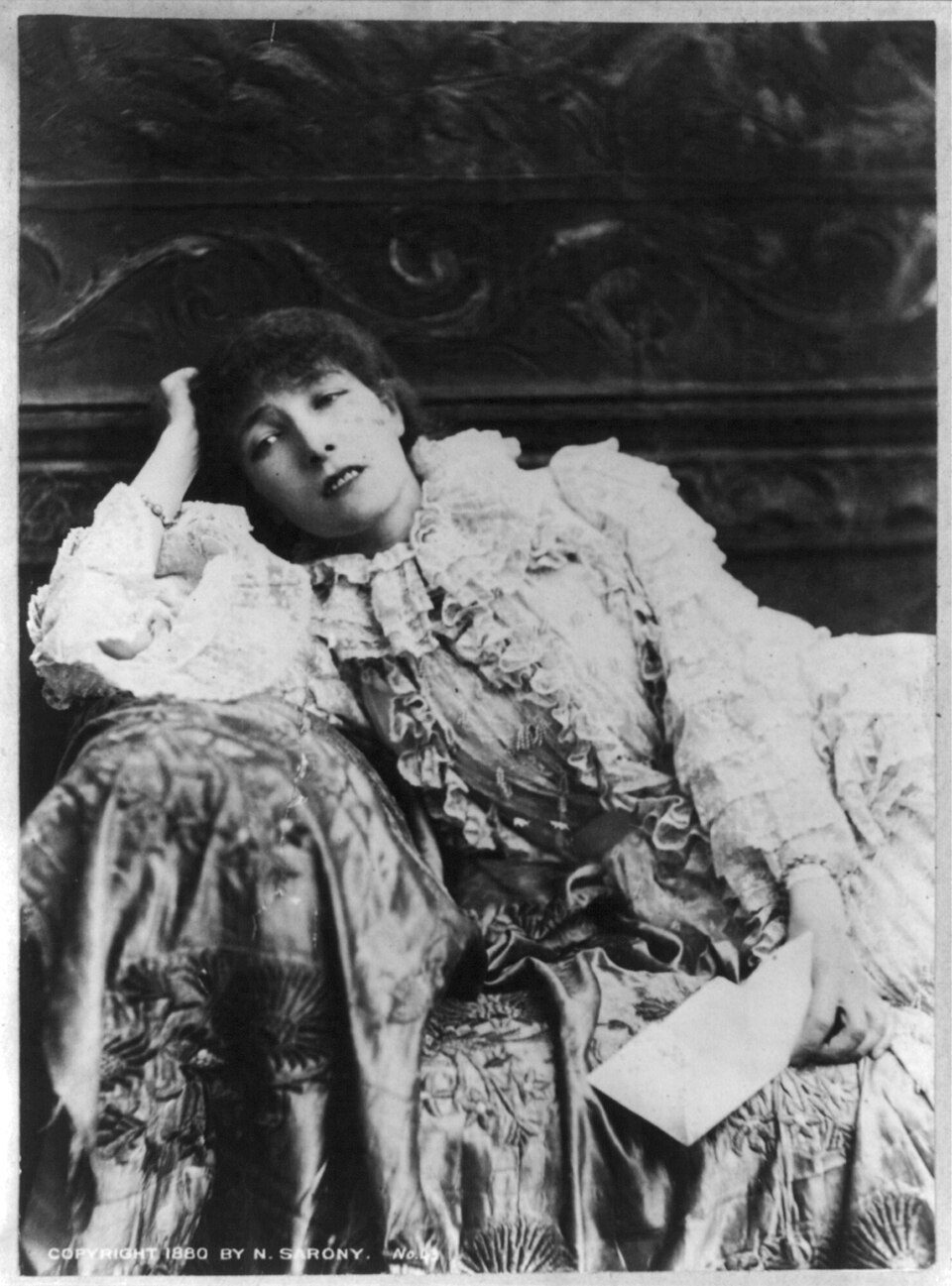
Who she was
Sarah Bernhardt (born Henriette-Rosine Bernard, 22 or 23 October 1844, Paris -- 26 March 1923, Paris) was the most famous French stage actress of the century. She made her name at the Odéon in François Coppée's Le Passant (1869), became a member of the Comédie-Française in 1872 (sociétaire from 1875) and left it in 1880 to run her own company and to tour Europe and America. She also painted and sculpted and exhibited at the Salon, which is why Marie always judged her both as an actress and as a rival artist (Wikipedia, "Sarah Bernhardt"). Her one marriage, to the Greek diplomat-turned-actor Jacques (Aristidis) Damala, took place in London in April 1882 and soon failed (Wikipedia, "Jacques Damala").
Marie and Sarah Bernhardt
Marie saw her on stage only a handful of times and knew her chiefly through Bojidar Karageorgevitch, the young Serbian prince who in 1881--1882 was her devoted companion. What Marie writes is a mixture of envy, scepticism about publicity and real admiration for the voice.
Paris, 1879--1880: the public figure
On 23 October 1879 she describes the Trocadéro concert organised by Coquelin for the actors' association, at which Adelina Patti's reception eclipsed Sarah, who "a fait faux bon" (086.0416). On 25 February 1880 she goes to the Théâtre-Français for the fiftieth anniversary performance of Hernani, where Sarah speaks lines by Coppée and the poet and Victor Hugo are acclaimed (087.0539). On 12 January 1880, after a successful evening of amateur theatricals at her mother's salon, she jokes "Pauvre Sarah Bernhardt!" (087.0189), and in May 1880 she thinks that in St Petersburg "on se marie très facilement quand on est une Sarah Bernhardt, genre honnête comme moi" (088.0427).
1881--1882: Bojidar's idol
In May 1881 the painter Louise Abbéma, "la célèbre amie de Sarah Bernhardt", compliments her Salon picture (091.0545). That summer Bojidar and his brother Alexis are "tout à Sarah": Bojidar insists that she hates publicity, and Marie, jealous, concedes that she is "gracieuse et séduisante et intelligente" but that "sa sculpture et sa peinture valent zéro" and that her success owes much to the "mise en scène" (093.0022--0026, 24 August 1881). On 28 August Bojidar tells how at eight he fainted at Le Passant and now lodges and dines at her house (093.0035). On 16 September, on the way to Biarritz, Marie sees her in La Dame aux camélias at Bordeaux from the balcony and writes that she has seen her only four times before -- in Le Sphinx six years earlier and later in Le Sphinx, Hernani and L'Étrangère; her verdict is that "je crois qu'elle est ravissante" (093.0079--0080). She fantasises about playing Marguerite Gautier so well that Sarah would become "laveuse de parquet" (092.0339).
In March--April 1882 Bojidar telegraphs Bernhardt from Nice to offer her the family villa during her engagement there; Marie wants it "pour enrager Gambart", with whom the actress usually stayed (094.0353). Bernhardt declines (094.0361). On 1 April Bojidar tells the household that she once burst into tears in her dressing room and that he "called Felicie", her maid, instead of seizing the moment -- a story that becomes a family catchphrase (094.0360). On 5 April the news arrives that she has gone to London and married her leading man "Daria" (Damala) (094.0365--0369). On 25 May 1882 Marie attends the charity performance of La Dame aux camélias with Sarah and her husband as Armand and writes that Sarah "n'est pas si admirable qu'on dit" and that the husband plays rather well (095.0095--0096).
1882--1884: Russia, rivals and Macbeth
Marie's Russian relatives and the Russian press gave her a different measure. On 19 October 1882, in Poltava, she writes that Sarah was hissed at the St Petersburg station because the crowd expected a dark-eyed beauty, and that the Russian papers put Mlle Delaporte and Desclée above her; for Marie only "l'adorable musique de sa voix lorsqu'elle dit des vers" counts (096.0410--0411; she recalls the same anecdote on 26 November 1883, 102.0323). She can mock Bojidar's belief in Sarah's virginity (097.0073) and his "airs homme" when he teases about her (097.0106). On 16 December 1882 she writes, in a line of superlatives whose tone is hard to read, that Sarah "est divine, admirable, superbe, incomparable, splendide" (097.0247); on 28 April 1883 she sits at the Trocadéro matinée for the blind workshops, where Sarah plays Pierrot in Jean Richepin's pantomime Pierrot assassin (099.0232).
As an artist she appears indirectly: in June 1883 Marie lists "Sarah" among the portraits of the Exposition des portraits du siècle that moved her (100.0123), meaning the portrait by Jules Bastien-Lepage, and in July 1883 a photograph of it stands on the piano in Marie's own salon, where Bastien's brother bumps into it (100.0323). On 16 June 1884 she sees Macbeth in Richepin's translation with Sarah as Lady Macbeth: the male actors are "faux et théâtraux" but "Sarah, elle est toujours admirable, malgré que sa voix d'or est devenue une voix ordinaire" (104.0591--0593). On 24 July 1884 she is still irritated by Bojidar's story of how he got into Sarah's house (105.0303).
Related entries
- #Bastien_Lepage -- painted her portrait (1879)
- #Bojidar -- Prince Bojidar Karageorgevitch, her devoted companion in 1881--1882
- #Abbema -- Louise Abbéma, painter and friend of Bernhardt
- #Julian -- Part of the Paris art world Bernhardt inhabited
Sources
- Wikipedia (en), "Sarah Bernhardt": https://en.wikipedia.org/wiki/Sarah_Bernhardt
- Wikipedia (en), "Jacques Damala": https://en.wikipedia.org/wiki/Jacques_Damala
- Marie Bashkirtseff's diary, paragraphs cited above.
Většina tohoto glosáře vznikla s pomocí jazykových modelů umělé inteligence a byla ověřena podle uvedených zdrojů; chyby jsou možné. Pokud nějakou najdete, nahlaste ji prosím tlačítkem v horní části stránky.