Dina Babanina
Also known as: Dina Babanina, Babanina, Babanine, Mlle Babanine, Dina, Comtesse Dina de Toulouse-Lautrec, Countess Dina de Toulouse-Lautrec
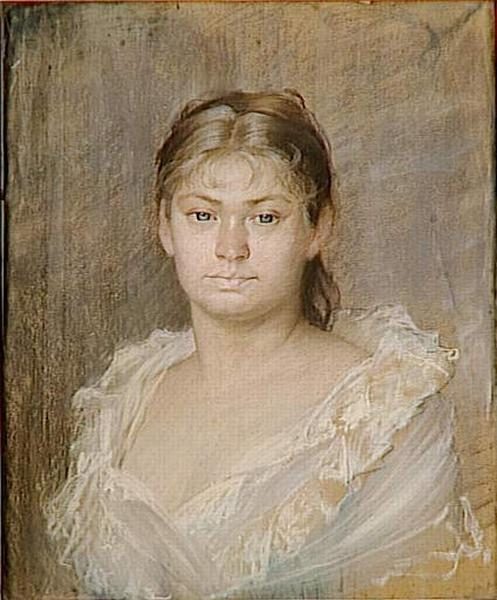

Dina Babanina
Who she was
Dina Babanina (Dina Babanine, 1855--1914), later Comtesse de Toulouse-Lautrec, was Marie's first cousin, raised in Marie's household, and the person most often named in the diary after Maman: the entry is tagged in more than a thousand daily entries between 1873 and 1884. Kernberger (2013, Appendix I, Glossary) gives "Babanine, Dina: Marie's cousin (1855-1914), daughter of George and Domenica". An earlier note on this page cites Geneanet (tree of Alain Garric) for a birth on 11 May 1855 at Poltava and a death on 26 July 1914 at Nice; the Geneanet page itself was not re-checked. Marie's own preface (written 1884) says Dina was born "quatre ou cinq ans avant ma naissance" (000.0035), i.e. about 1853--54, so 1855 is probably correct to within a year.
Family
Dina was the daughter of Marie's maternal uncle Georges Babanine (#Georges) and his wife Domenica Pavlovna Issaïevitch (Kernberger, Glossary). According to Marie's preface, Georges married at twenty "une belle veuve de trente-six ans, mère de plusieurs enfants" (000.0008); one of the widow's daughters, Marie née Kandiba ("Mashenka"), became the wife of Uncle Stepa Babanine. Dina's full siblings were Lola ("La fille est mariée", 000.0035; she married Alexander Nemerovsky per Kernberger, and Marie notes the wedding on 13 September 1882, 096.0237) and a brother, Stepan ("Etienne"), "mort à seize ans" (000.0035). On 25 January 1874 Marie reads in a Russian newspaper that Stepan, fifteen and a student at the military academy, had stabbed himself three times with a dagger at his mother's house (1874-01-25, in Kernberger's translation); Dina was not told. By February 1876 he is spoken of as dead (053, 1876-02-01). Kernberger's notes connect the suicide with Georges having his marriage to Domenica annulled, which left the children illegitimate (Kernberger 2013, notes).
At her birth Grand-maman "alla la prendre sans cérémonie à sa mère et la garda toujours", and Maman "adora Dina" (000.0035): Domenica "n'y tenait pas trop". Dina grew up in the Babanine household as a sister to Marie and Paul. She travelled with the family when they left Russia in June 1870 (000.0023).
Marie and Dina, 1873--1881
In the preface Marie remembers that at five, dancing as Petipa, she was the star: "Paul n'était presque rien et Dina ne me portait pas ombrage bien que fille du bien-aimé Georges" (000.0034).
In the first entries Dina goes out with Maman: "Maman et Dina sont à une matinée musicale à l'hôtel Chauvain" (30 January 1873, 001.0056). Marie weighs suitors for her: on 9 February 1873 Baron Bach is "assez bon pour Dina" (001.0121). On 23 September 1873 Grand-papa -- "papa" in that entry, not Constantin -- says "si l'on me demandait, je choisirais Dina", which Marie finds so mad that she decides he is old and blind (010.0008); Dina is the one who notes that the Duke of Hamilton is handsome "pour ceux qui l'aiment" (010.0031).
Through the Nice years she is Marie's walking companion, confidante and accomplice. They share clothes and ride to church. Marie says in despair, on 22 March 1875, "Pourquoi ne suis-je pas un morceau de viande comme Dina ?" (030.0302) and on 31 March that the family thinks it can keep her "comme Dina jusqu'à vingt ans" (030.0420): Dina stands for the conventional path she refuses. On 30 October 1875 the Sapogenikoff sisters arrive "déguisées en hommes" and Marie and Dina do the same -- "nous sortons après avoir fumé, juré, dit des horreurs" (048.0252). In November 1875 Marie has her anonymous letters against the Audiffret family posted from Nice by Dina (1875-11-18 and 11-19, 050.0032), and Dina reports on the Audiffrets' humiliation at the opera on 28 November (050.0248).
In Rome in spring 1876 Dina is her companion at the Pincio and the Corso (055.0525, 11 March) and a source of indiscretion: she tells Bruschetti that Marie "est amoureuse d'Antonelli et ensuite amoureuse de Doria" (055.0088). On 10 June 1876 it is Dina's idea to order a mock mourning card, "Mlle Dina Babanine ... est décédée dans sa dix-huitième année", for Antonelli at a Roman printer's; Marie decides on reflection not to send it (062.0311). On 22 April 1877 Dina copies out a letter Marie sends to Larderel (070.0819).
After the move to Paris in 1877 Dina is part of the household at 34 avenue Montaigne, and sits for Marie from 1879 on (see below). When Marie imagines marriages for the people around her she turns to Dina: on 21 May 1883 she regrets that Dina "n'ait pas trois cent mille francs de dot", which would suit Tony Robert-Fleury, "bon, honnête, bien élevé" (099.0513).
1882--1884
1882. On 3 May Marie jokes that she would marry Julian to Dina (095.0017); on 18 July, as Dina fills Julian's glass at dinner until he is drunk, Marie writes: "cette fille-là est d'une couleur ravissante, elle a des cheveux merveilleux, un type intéressant, elle est bonne... Mais quand elle veut être gracieuse elle a quelque chose de lascif qui m'horripile et puis ce manque de mesure en tout !" (095.0300--0302). In August she thinks of marrying Dina to Tony instead (096.0054) and plans a portrait of her, "avec une pointe de mystère ... dans ses yeux de chat" (096.0107). Dina goes to Russia with Maman on 6 August (096.0019) and meets Marie at Poltava station in October (096.0389); at Gavronzi Marie is irritated by her flirting with Michka Eristoff, whom she "a battu pour de vrai" (097.0011).
Winter 1882--83. "A Nice entre Dina, Bojidar, Nini, avec ces êtres jeunes j'étais tout autre", Marie writes on 5 December 1882, regretting how different she was before Paris (097.0193). On 27 January 1883 Dina is one of the three women who pray for her night and morning (098.0178). On 2 February Dina, thinner, is "magnifique" and "des artistes raffolent de ses yeux chinois, de ses lèvres épaisses"; Marie wants to paint "cette Vénus de Milo, de Rubens ou plutôt de Rembrandt" for the Salon (098.0269). The study of 27 January, which Dina poses for with "nonchalance", is judged "au dessous de ce que je puis faire" (098.0166).
Salon 1883. On 30 March 1883 a member of the jury writes that "la tête au pastel, le portrait de votre cousine" has had a real success (098.0634). The pastel won Marie's mention honorable: on 24 May she goes to look for the placard "mention honorable", expecting it on her Irma, and finds it on "l'odieux pastel" (099.0565); Bojidar and Dina then go to complain at the Salon office, in vain, and Bojidar takes the placard away for her, "ce morceau de carton avec les mots: mention honorable" (099.0594). After the awards Dina and Ma tante told a journalist of the great paper about Marie's youth (100.0182) and sat behind her at the ceremony on 22 June (100.0191). On 19 July Dina, Bojidar and Ma tante understand only that "elle prêche l'égalité avec les domestiques et les paysans" (100.0385).
The portrait that failed, 1883--84. On 24 July 1883, rain keeping her indoors, Marie begins a new portrait of Dina (100.0425); in September she works on it in a "disposition d'esprit si tragique" (101.0343), and on 9 October plans to show it with her portrait of Bojidar at an exhibition (101.0558). On 28 November it is "une harmonie blanche ... superbe" (102.0342); on 7 December Dina's migraines stop the sittings (102.0443). On 14 January 1884 Marie slashes the canvas ("j'ai crevé le portrait de Dina", 103.0037), begins again on 28 January (103.0156), reaches "la pose rêvée" on 19 February (103.0348), and on 24 February erases the head after visitors' remarks (103.0396). By 6 March, "son tableau me coûte le portrait de Dina": the Meeting had taken all the time (103.0454). The portrait is not recorded as finished. The pastel, by contrast, was lent to Mme Bertaux's association of women painters and sculptors in March 1884 (103.0437) and the dealer Hayem wanted to buy it in May 1884 (104.0175).
Marriage plans. On 20 October 1883 "il est très question d'un mariage entre Dina et" a man, apparently the young Marinovitch named in the previous paragraph, thirty-three and a secretary at an embassy, who "la trouve charmante" -- "seulement ces gens s'imaginent que Dina est très riche" (102.0037--0038; see #Marinovitch). Nothing came of it in the diary.
Spring--summer 1884. Dina is Marie's go-between and, increasingly, her foil. On 2 May Marie is irritated when Dina cheats at a measuring of their heights ("elle fait semblant" to take off her slippers); yet "elle est très bonne et soigne les malades de la maison" and "fait maigre et va à l'église et croit aux images miraculeuses. Moi ces natures me dégoûtent" (104.0085--0087). On 18 May Dina keeps Emile Bastien-Lepage and Bagnitsky late so that it is "trop tard pour des explications en famille" (104.0237). On 23 May Tony Robert-Fleury takes Dina aside and tells her he can say neither yes nor no, "que j'ai des chances mais on ne sait jamais" (104.0306); on 28 May Julian writes to Dina that he is ashamed for Marie and asks her not to think him capable of "vilenies" (104.0416). On 16 May, listing those for whom she would sacrifice her dog Coco -- Bastien-Lepage first -- Marie adds "Et pour Dina et pour ma tante et pour maman et pour Paul", but not Engelhardt or Missak (104.0199).
Bastien-Lepage's illness and Marie's last weeks. On 1 July 1884 Dina will not go with her to see Jules, "elle affecte de croire que je fais trop d'honneur à ce malade", and says that Mme Mackay is there (104.0756); on 17 July Marie explains to her that Bastien-Lepage "n'est pas gentil" (105.0231). On 20 August Dina finds her lying at home: "Tu ne vas donc pas voir Jules ?" (105.0609--0610). On 24 August Dina, "qui joue les ingénues, toujours", asks the architect whether the woman who visited his brother was Mme Mackay (105.0664); on 26 August Marie, jealous, writes "l'égale de Dina ou de ma tante" and on the 27th that Jules "m'aime mieux que maman, ma tante ou Dina... Et encore ce n'est pas sûr" (105.0682, 105.0694).
From September Dina is the strongest of the household. On 14 September, too weak to climb the stairs, Marie is carried up "suivi de Dina" (106.0049). On 23 September Dina calms the dying painter by stroking his head -- "Elle est si bien portante, si grasse, si forte que c'est à elle qu'il l'a demandé" (106.0114) -- and on 1 October she does it again (106.0136). On 11 October "Dina se précipite" as Marie shivers by the fireplace (106.0167). On 16 October "Dina me lit des romans" (106.0179). In the last entry of the diary, 20 October 1884, Marie describes how Emile Bastien-Lepage carries his brother up and down three flights of stairs on his shoulders: "Emile est un frère admirable ... Mais j'ai dans Dina un dévouement pareil" (106.0193). Marie died on 31 October.
In Marie's art
Marie painted Dina repeatedly. The pictures established so far:
- Jeune femme lisant « La Question du divorce » (1880, 130 × 98 cm, private collection): Marie's Salon debut under the name "Marie Constantin Russ"; sitter Dina.
- Die Lesende (c. 1880, 64 × 53 cm): sold at the Dorotheum, Vienna, on 7 June 2021 for EUR 149,700 (including premium), a record for the artist, with Dina named as sitter. The catalogue calls it the first variant of the composition of which the second is at Kharkiv (Dorotheum lot 7201837). It says that Marie cut up a version she thought unsuccessful, that her mother kept and pasted the canvas back together, and that in 1910 Maria Bashkirtseff lent it to the Vienna Secession exhibition Die Kunst der Frau and left it in Vienna as a gift to Margarethe Stonborough-Wittgenstein (1882--1958) (Dorotheum; Antiques Trade Gazette, 25 August 2021). Whether the diary mentions this canvas is not established.
- Portrait de la comtesse Dina de Toulouse-Lautrec: pastel on paper, 61 × 50 cm, exhibited at the Salon of 1883 as Portrait de Mlle de B. and honoured with the mention honorable; given to the French state by Marie's mother in 1892 (Musée d'Orsay, RF 39091; the verso inscription calls her "Comtesse Dina de Toulouse-Lautrec", so it was written after her marriage). The art entry argues that the pastel was made in spring 1882, not 1883.
- A pencil drawing endorsed "Dina" and other sketches of 1882--95 are in the British Library (SNAC ark:/99166/w6zx1qnd).
- The oil portrait of 1883--84 described above was not finished (or does not survive).
After 1884
The Orsay inscription and the Dorotheum notes agree that Dina married a Comte de Toulouse-Lautrec; one popular article puts the marriage two years after Marie's death, in 1886 (mydailyartdisplay.uk, 14 February 2015). The husband's identity is not established. An earlier version of this page gave "Comte Alexandrine de Toulouse-Lautrec (1836--1894), about thirty-one years her senior"; "Alexandrine" is a woman's name and 1836 to 1855 is nineteen years, so that sentence was unreliable. Kernberger's glossary lists a "Cousin Alexander (1836-1893), son of Uncle Toulouse-Lautrec" -- the son of the elderly Count Alexander Toulouse-Lautrec ("Uncle Sacha", 1807--1885), whom Kernberger calls Marie's great-uncle -- which may be the husband but is not confirmed by any source seen. Dina died, according to Kernberger and Geneanet, in 1914, in Nice.
Related entries
- #Maman, #Ma_tante, #Paul, #Georges
- #Bojidar: in 1883--84 the "Dina" named beside Bojidar is Dina Babanina, not any sister of his (earlier LAN notes in carnets 099--100 that read "Dina Karageorgevitch, Bojidar's sister" are wrong)
- #Question_du_divorce, #Die_Lesende, #Portrait_de_Dina
Sources
- Marie Bashkirtseff, Journal (paragraph references as cited), esp. preface 000.0008--0035.
- Katherine Kernberger, I Am the Most Interesting Book of All / Lust for Glory (Fonthill Press, 2013): Appendix I Glossary; notes.
- Musée d'Orsay, notice of RF 39091; Dorotheum, lot 7201837 (7 June 2021) and press release "Sensational prices for Markus Pernhart and Marie Bashkirtseff"; Antiques Trade Gazette, 25 August 2021, "Slashed and rejected canvas now worth 120,000"; SNAC, ark:/99166/w6zx1qnd (British Library holdings).
- mydailyartdisplay.uk, "Marie Bashkirtseff. Part 1 The portraitist and feminist", 14 February 2015.
Most of this glossary was researched with the help of AI language models and checked against the sources cited; mistakes are possible. If you spot one, please report it with the button at the top of the page.