L'Atelier Julian
Також відомий як: L'Atelier Julian, L'Académie Julian (tableau), un atelier de femmes, In the Studio, У студії, Майстерня Жюльєна
Overview
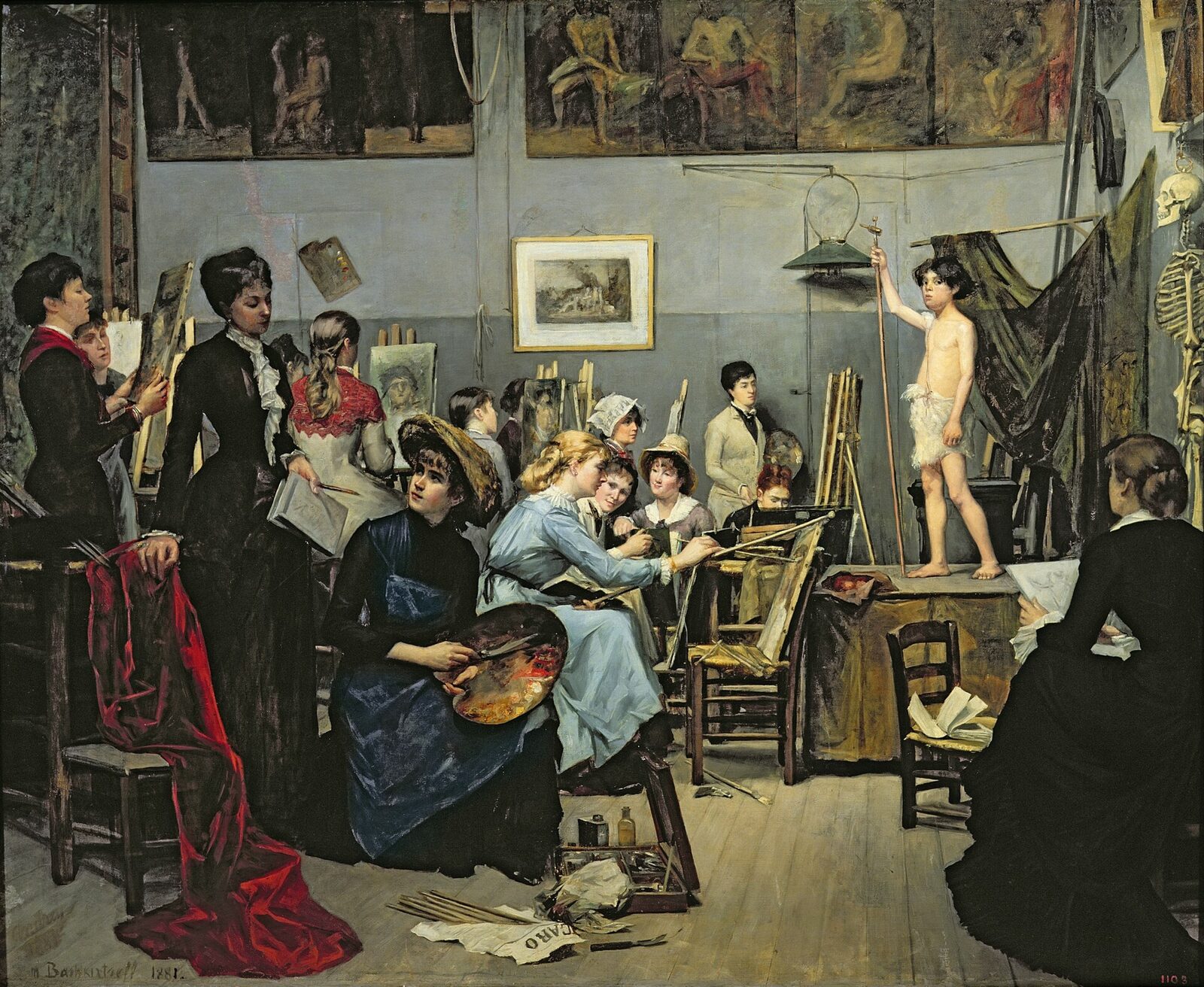
L'Atelier Julian (1881, oil on canvas) is Marie Bashkirtseff's first Salon picture on a large scale and her only painting of the place where she spent her working life: the women's atelier of the Académie Julian. It was shown at the Salon of 1881 under the pseudonym Andrey. It survives in the Dnipro Art Museum in Ukraine, on permanent display -- one of only three Bashkirtseff paintings left in the country -- and, as of 2026, no inventory number for it has been published.
Its dimensions are disputed. The 1885 posthumous catalogue, closest to an authorial checklist, gives 1,45 × 1,85 m; AWARE (published with the Musée d'Orsay) gives 165 × 185 cm; the image-library metadata that circulates via Wikidata gives 188 × 154 cm; French and English secondary literature gives 154 × 186 cm. The museum publishes no online catalogue that could settle it. The 1885 figure and the "154 × 186" of the secondary literature are close enough to support each other; the safest citation is "c. 145–155 × 185 cm".
Description
Sixteen women students at work in a life class: a nude child model posed on the platform, easels crowded to the edges of a room too small for them, the studio's clutter of casts, canvases and stove-pipe. Marie put herself at the centre of the group, in blue. Nothing like it existed -- that was Julian's whole commercial point -- and the composition is, in effect, a group portrait of the institution that took women seriously as professionals a decade and a half before the École des Beaux-Arts would.
The picture illustrates the ethos Marie had set down in her own words as a beginner in October 1877 (075.0162): "A l'atelier tout disparaît, on n'a ni nom, ni famille; on n'est plus la fille de sa mère, on est soi-même, on est un individu et on a devant soi l'Art et rien d'autre."
Making of the Work
The picture was a commission, and the commission was a bargain: on 24 December 1880 Rodolphe Julian offered her a subject that would make her name two days after the Salon opened, on condition that the canvas be his at whatever stage of finish -- an engagement she and Amélie signed in writing, with Magnan and Magdeleine as witnesses (090.0418). Marie got "un coin de notre atelier avec trois personnes sur le premier plan grandeur nature"; Amélie got the whole rue Vivienne studio in small. "Jamais un atelier de femmes n'a été fait," Marie wrote (090.0419) -- and she noted Julian's three motives without illusion: he had no time to paint it himself, he wanted to please her, and he wanted to enrage Breslau (090.0422). She also suspected he wanted her bogged down in a picture too big for the time available.
The making of it was a three-month war with the room itself. She could not compose the esquisse without knowing where she would be allowed to stand and how much space she would be given; Julian jeered at her through the acoustic tube; her letter to him survives in full in the diary -- "Je n'ai jamais demandé qu'on démolisse la maison mais il faudrait m'accorder un certain espace" (090.0444). The perspecteur's ruling upended the whole design -- she had to imagine herself six metres further back than the wall allowed -- costing four or five days and a 25-minute lecture on his infallible rules (091.0072, 091.0091). Alice Brisbane and Villevieille were her principal models (091.0048); Brisbane's head was painted in two hours and Julian told her to leave it alone (091.0090).
By late February the verdict had turned: "il dit que j'ai fatigué ma toile" -- she had overworked the canvas (091.0163), a reproach she repeated against herself when it was done (091.0286). The finish, on 18 March 1881, was a crisis: the three principal central figures repainted, Tony Robert-Fleury praising passages but not the whole, and Julian declaring "qu'il est furieux de m'avoir donné cet épatant sujet pour mon premier tableau" and hinting he would be charmed if she withdrew it (091.0271–0288). Amélie painted the small head in the middle for her; Bojidar walked the porters to the Palais de l'Industrie (091.0290–0295). There was a caricature painted into a corner of the canvas, which Amélie later erased, to Marie's fury (091.0409–0416).
She signed it Andrey -- "Aussi bien français du russe, André si dit Andrey en russe et ça commence par un A" (091.0297): a name beginning with A would place her early in the alphabetical livret and let her learn her fate sooner. (Her 1880 debut had gone in as "Marie Constantin"; from 1882–83 she signed her own name. Julian, recalling the affair later, misremembered the pseudonym as "Audrey", 092.0433.) The picture was accepted on 1 April with a jury classification of numéro 2 (091.0371–0372) -- the likely source of the Ukrainian press formula that the jury "placed it second". On opening day her name had been left out of the catalogue by error; she had it corrected, and Louise Abbéma sent word that she liked it: "c'est viril, amusant" (091.0510–0514). It hung between a portrait by Wolff and Bastien-Lepage's Mendiant. Jules Lefebvre, introduced by Julian, told her there were great qualities in it (091.0532); she petitioned the administration, unsuccessfully, to have it hung lower (091.0539). No award came: Julian had tried for her and for Breslau, Breslau got it, "moi ça ne prend pas. Ce n'est pas assez peint" (091.0588–0590). Her own review of the Salon appeared in La Citoyenne (091.0597), and rather than attend the prize-giving she left for Russia (092.0001).
Afterlife
The canvas travelled with the bulk of her work: from her mother to the Museum of Alexander III in St Petersburg in the first decade of the twentieth century, and on to Soviet Ukraine in 1930 or 1932 -- the sources do not agree which consignment carried it. It did not go to Kharkiv, where sixty-five of her canvases were lost in the war, and it is now the best-known Bashkirtseff painting in Ukraine. The Dnipro Art Museum's façade and windows were damaged by Russian strikes on 30 September 2025 and again on 16 April 2026, and its anniversary displays were restored on 6 June 2026; the condition and whereabouts of this picture have not been reported individually.
References in Diary
- Precursor: 1877-10 (075.0162) -- the atelier as a place where name and family disappear; the idea the picture illustrates
- First mention: 1880-12-24 (090.0418–0422) -- Julian's offer, the signed engagement, "jamais un atelier de femmes n'a été fait", and his three motives
- 1880-12-27 (090.0440–0444, 090.0451) -- she cannot compose without knowing her allotted space; her letter to Julian in full
- 1881-02-05 (091.0039) -- Tony: "Le point de départ est bon, cela va bien"
- 1881-02-06 (091.0048) -- the picture back on track; Villevieille and Alice Brisbane as principal models
- 1881-02-12 (091.0072), 1881-02-13 (091.0091) -- the perspective expert overturns the composition
- 1881-02-13 (091.0090) -- Brisbane's head painted in two hours
- 1881-02-27 (091.0163) -- Julian cools: "j'ai fatigué ma toile"
- 1881-03-06 (091.0218), 1881-03-07 (091.0236) -- one of Julian's own canvases punctured behind hers, and she pays for it, as well as for the frame of the picture she is painting for him
- 1881-03-07 (091.0226–0228, 091.0239) -- Villevieille's daughter posing; Julian discusses her faults as a painter in front of the model
- 1881-03-13 (091.0254) -- dread of being mocked by the men's studio downstairs
- 1881-03-18 (091.0271–0288) -- finished, and the crisis: the central figures repainted, Julian's fury at having given her the subject
- 1881-03-20 (091.0290–0295) -- Amélie paints the little head; the canvas carried to the Palais de l'Industrie
- 1881-03-20 (091.0297) -- the signature: "J'ai signé Andrey, ce sera mon nom"
- 1881-03-27 (091.0355), 1881-04-01 (091.0371–0372) -- Breslau accepted first; then her own admission, with numéro 2
- 1881-04-08 (091.0409–0416) -- the caricature in the corner of the canvas, erased by Amélie
- 1881-05-01 (091.0510–0514) -- opening day: her name omitted from the catalogue; Abbéma's "c'est viril, amusant"; hung between Wolff and Bastien-Lepage's Mendiant
- 1881-05-03 (091.0522), 1881-05-06 (091.0532), 1881-05-07 (091.0539) -- people stop to look; Jules Lefebvre's praise; her failed petition to have it rehung lower
- 1881-05-14 (091.0588–0590, 091.0597, 091.0600) -- no award; Breslau takes it; her Salon review in La Citoyenne
- 1881-05-15 (092.0001), 1881-08-18 (092.0433) -- she leaves for Russia rather than attend the prize-giving; Julian later admits he tried the award for "Audrey" first
Related Entries
- #Academie_Julian -- the school, the room, and the routine the picture records
- #Rodolphe_Julian -- who commissioned it, owned it, and regretted it
- #Art_practice -- Marie's work as an artist
- #Salon -- the annual Paris exhibition
- #Tony_Robert_Fleury -- her teacher
- #Louise_Breslau -- her rival, who took the 1881 award
- #Amelie -- who had the rival commission and painted one head of this canvas
- #Alice_Brisbane -- one of the models
- #Jules_Lefebvre -- the visiting professor who praised it
- #Un_meeting -- the Salon picture of 1884
Sources
- Catalogue des œuvres de Mlle Bashkirtseff, Union des Femmes Peintres & Sculpteurs, Paris: Ludovic Baschet, 9 February 1885, no. 23 (1,45 × 1,85 m; "Salon de 1881") -- Gallica ark:/12148/bpt6k131932r. The same catalogue's notice signed "Une Amie" is the primary source for the pseudonym "Andrey".
- AWARE — Marie Bashkirtseff (165 × 185 cm)
- Дніпровський художній музей — uk.wikipedia and the museum's audio guide on izi.TRAVEL
- Ukrinform, «Марія Башкирцева. Замурована в мистецтві»
- Image: Wikimedia Commons, In the Studio, public domain
- All diary quotations from the French originals in `/content/_original/`