Albert Wolff
Also known as: Wolff, Albert Wolff, M. Albert Wolff, Wollf, Wolffisée

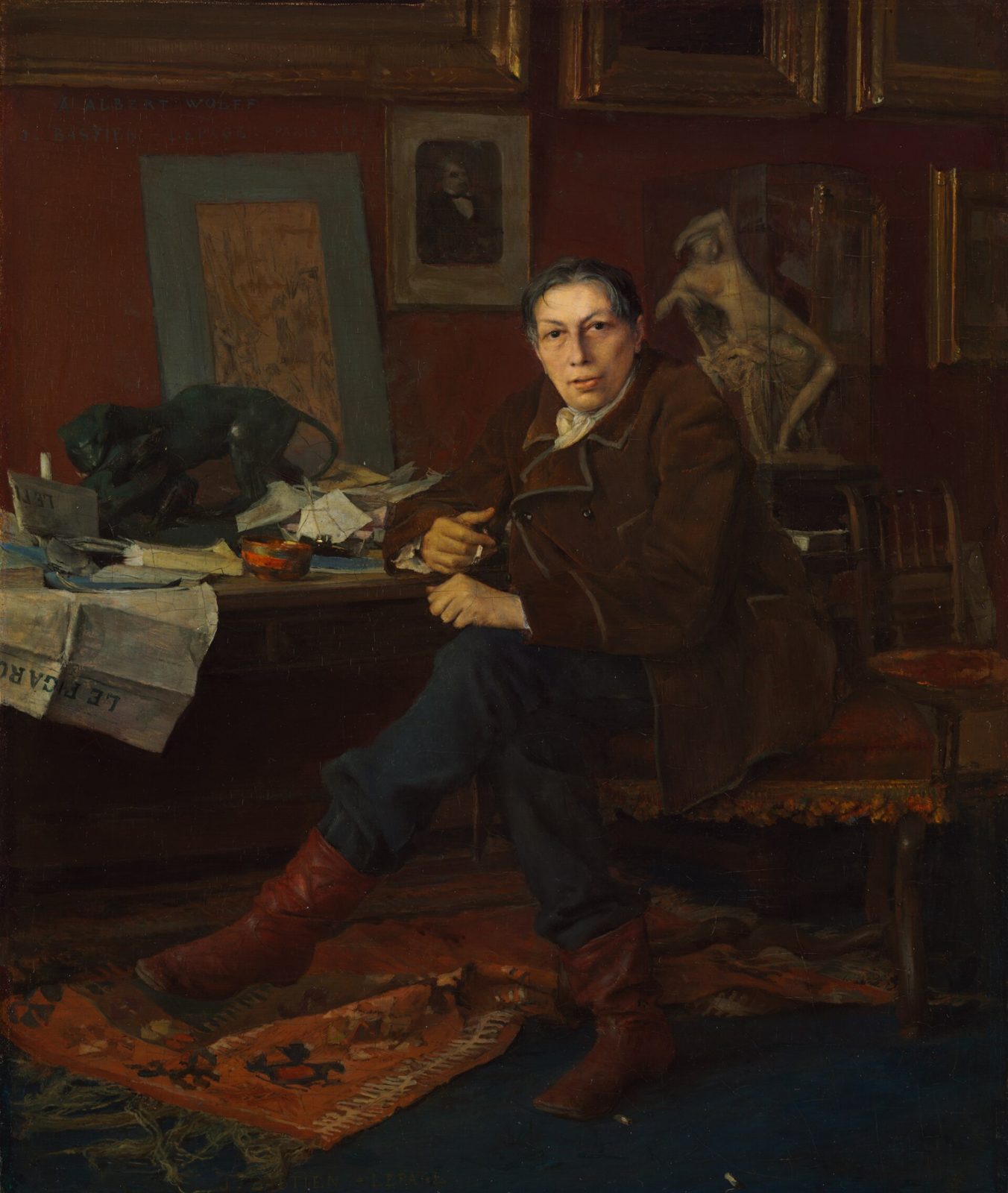
Who he was
Albert Wolff was the most feared newspaper critic in Paris in Marie's day: the art critic and chronicler of Le Figaro, and the man whose paragraph on a young painter at the Salon could open or close a career. He was born in Cologne and came to Paris in 1857 to report the Salon for the Gazette d'Augsbourg; after a short time as a secretary to Alexandre Dumas he wrote for Le Gaulois, caught the eye of the Figaro's founder Villemessant, and joined Le Figaro and Le Charivari in 1859 (fr.wikipedia, "Albert Wolff (journaliste)"). He became a French citizen in 1871 (Musée d'Orsay catalogue entry for the Legé & Bergeron portrait caption). He died in Paris on 22 December 1891, unmarried, and is buried at Père-Lachaise (fr.wikipedia).
His birth year is given two ways. The BnF authority record and Wikipedia say 31 December 1825; the Musée d'Orsay, the INHA's AGORHA database and the Père-Lachaise cemetery association give 1835. The 1825 date fits his arrival at the Salon as a working critic in 1857; the project's earlier notes used 1835.
He wrote Mémoires du boulevard (1866), La Capitale de l'art (1886) and, from 1885, the yearly Figaro-Salon. He disliked the Impressionists, although he sometimes praised single works by them (fr.wikipedia). On 30 April 1880 Marie tells her diary to see "how Wolff treats the gallery", although it holds works by Renoir and other known painters (088.0041).
Two portraits of him show how the art world saw him. Édouard Manet painted him in 1877 (Kunsthaus Zürich), and Jules Bastien-Lepage -- the painter Marie most wanted as her master -- painted him in 1881 at his desk, with a copy of Le Figaro spilling off it; the canvas is inscribed to him and now hangs in Cleveland.
Marie and Wolff
Wolff never appears in the diary as an acquaintance. He is a name, a power and, for Marie, an object of longing and dread. Whether he ever wrote a line about her is not recorded in the diary; she records only his silences.
Before the studio years. On 21 June 1879 she writes that she will only repeat "the moved, true and beautiful words of Albert Wolff of the Figaro" on the death of the Prince Imperial (085.0387). On 24 March 1880 she explains that Tony Robert-Fleury's career stalled when an enemy gained influence over "that terrible journalist" (087.0694).
February 1882: Breslau. In early February 1882 Wolff gave about twenty flattering lines of the Figaro to her rival Louise Breslau. Marie is "cooked" (094.0230, 7 February), sick whenever she thinks of "that article" (094.0240), "crushed, annihilated" -- but, she says on 13 February, the blow did her good and sent her back to serious work, which led to the street-boys study that became Un meeting (094.0249). On 27 February she is still "half stunned by Wolff's few lines" (094.0293). In September 1882 she recalls that Breslau's 1880 pictures hung in the outer gallery of the Salon, which Wolff had called "the Morgue" (096.0309). In November 1882 the name alone gives her "a seizure" (097.0024).
1883: courting the Figaro. On 1 January 1883 she hopes that a portrait of the daughter of the Figaro columnist Étincelle would earn publicity and be shown to Wolff, as Breslau's portrait of the Figaro administrator's daughter was (097.0339). On 11 April she dismisses him as "too much shop and studio" to write about Saint-Marceaux's Arlequin as a philosopher would (099.0103). On 22 April she writes to the architect Émile Bastien-Lepage hoping to head off "a machination" that would bring unfriendly lines from Wolff on her exhibition, noting that Wolff "does not know me" (099.0178-0179). On 30 April Wolff had given Breslau a few lines and her nothing (099.0259). On 4 May she hears that Fourcaud, "the second Wolff", has looked twice at her picture and that she may get an article (099.0360). On 13 July, after the Russian article, the Maréchale says she will have Francesqui bring Wolff to her (100.0328). On 26 August she sets out how protection works at the start of a career: a pupil with promise is presented to the public by "a Wolff", and "the great, great, great question is: shall I be Wolffised next year?" (101.0258, 101.0260).
1884: the last Salon. On 12 January 1884 the sculptor Jules Franceschi says he will speak of her picture to "his intimate friend Wolff" (102.0670). In January 1884 her mock Montmartre street-song about Jules Bastien-Lepage ("Adolphe") has him "dropped at last by Albert Wolff" (103.0013, 12 January; again 103.0193, 31 January), and on 2 February she addresses the critic directly: "O Albert Wolff, you know nothing about art, they say, but if you would deign to stick an article on me..." (103.0231, 2 February). In the half-sleep of 16 March his name is one of the words she mutters (103.0541). On 1 April she notes that Wolff is writing about the exhibition in the rue de Sèze that opens that evening (103.0650). When the Salon opens she is hurt: "How is it that Wolff has said nothing of my picture? Is he an idiot?" -- he has perhaps not seen it, since he was doing room 17 (104.0134, 8 May 1884). On 17 July she is moved to see him among the mourners at an artist's funeral in her street (105.0229). In the last carnet she imagines, on 23 September 1884, a letter from the Figaro illustré announcing that her drawing was accepted and "particularly noticed by our colleague M. Albert Wolff" (106.0108).
Related entries
Sources
- "Albert Wolff (journaliste)", Wikipédia en français (https://fr.wikipedia.org/wiki/Albert_Wolff_(journaliste)), for career and works.
- BnF, data.bnf.fr authority record "Albert Wolff (1825-1891)" (https://data.bnf.fr/fr/12017658/albert_wolff/), for birth date 31 December 1825.
- Musée d'Orsay, "Albert Wolff né à Cologne en 1835, naturalisé français en 1871, mort en 1891, journaliste" (Legé & Bergeron, https://www.musee-orsay.fr/en/artworks/albert-wolff-ne-cologne-en-1835-naturalise-francais-en-1871-mort-en-1891-journaliste-64594); INHA AGORHA, "Wolff, Albert (31/12/1835 - 22/12/1891)".
- Cleveland Museum of Art, Bastien-Lepage, Albert Wolff in His Study, 1881, inv. 2010.22 (https://clevelandart.org/art/2010.22).
Most of this glossary was researched with the help of AI language models and checked against the sources cited; mistakes are possible. If you spot one, please report it with the button at the top of the page.