Jeanne d'Arc (Bastien-Lepage)
Also known as: Jeanne d'Arc de Bastien-Lepage, la Jeanne d'Arc de Bastien-Lepage, Jeanne d'Arc, Joan of Arc (Bastien-Lepage), Jeanne d'Arc de Bastien
Overview
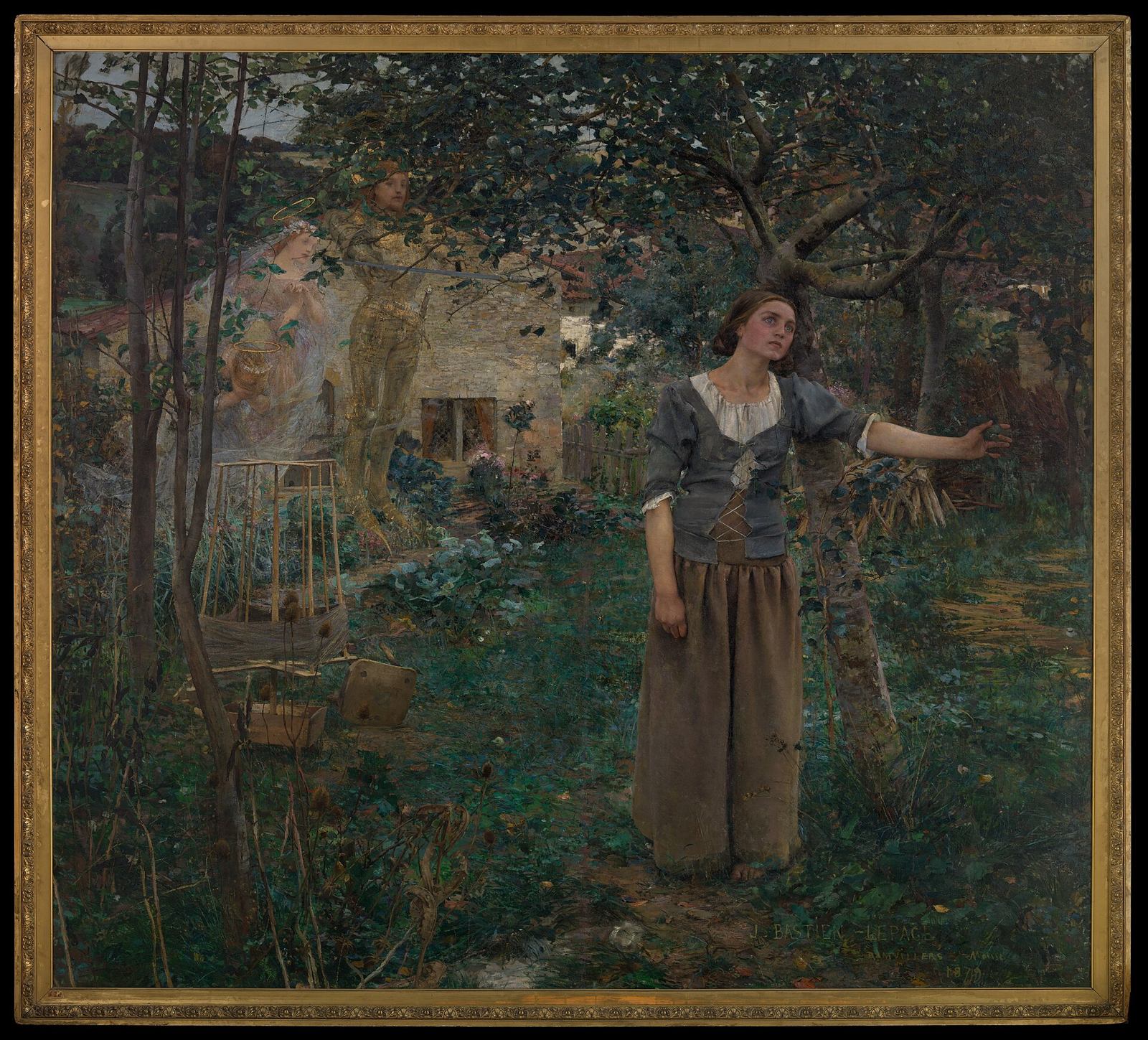
Jeanne d'Arc (1879) is the large history painting by Jules Bastien-Lepage in which the peasant girl Joan of Arc, in her parents' garden at Domrémy, hears the voices of Saints Michael, Margaret and Catherine, who appear faintly in the foliage behind her. It is oil on canvas, 254 × 279.4 cm, in the Metropolitan Museum of Art, New York (accession 89.21.1, Gift of Erwin Davis, 1889). It was shown at the Salon of 1880 and bought that year by the New York businessman Erwin Davis. (Sources: Metropolitan Museum of Art, object record 89.21.1 and its essay on the painting; French Wikipedia, « Jeanne d'Arc (Bastien-Lepage) ».)
Bastien-Lepage, a native of Lorraine, painted the subject in the years when Joan had become a patriotic emblem after the annexation of Alsace-Lorraine by Germany (1871). The Met's essay records that critics at the Salon of 1880 praised the pose and the face, which convey Joan's spiritual awakening, but found the ghostly saints at odds with his naturalist manner; the heavily worked, flickering background of the garden was the other recurring complaint. (Sources: Metropolitan Museum of Art; French Wikipedia.)
Marie and this painting
Marie first saw it at the Salon of 1880 and wrote on 30 April 1880 that this was « Jeanne d'Arc, la vraie, la paysanne appuyée à un pommier » -- the right arm hanging at her side, the left hand on a branch (088.0046). On 16 May she went to the Salon alone and looked hard at it: the head is « sublime » but « le paysage est déplorable, plus on le regarde, plus cela fait de la peine » (088.0204, 088.0207). On 20 June 1880, the day the Salon closed, she repeats the verdict -- the landscape « nuit à sa figure, mais quelle admirable figure ! » (089.0006).
The painting stayed with her for the rest of her life. In August 1882 she writes that nothing in painting has ever touched her as much as « la Jeanne d'Arc de Bastien-Lepage » (096.0171). In May 1883, when she is shown Bastien-Lepage's new L'Amour au village, she defends the earlier picture's flickering landscape as true to nature (099.0335), remembers it as « une merveille » and wants to see it again (099.0543, 100.0121); on 19 May 1883 she even writes to America to ask whether « M. Davis qui a volé pour vingt mille francs la Jeanne d'Arc » would sell it back (099.0498) -- the figure of 20,000 francs is Marie's own, not confirmed by the Met. On 16 June 1883 it is one of the five canvases she lists as proof of Bastien-Lepage's stature (100.0167).
In January 1884 she declares that L'Amour au village is « inférieur, bien inférieur à Jeanne d'Arc » and that critics praise the peasant scenes only to confine him to a speciality: « Furieux que cet homme qui a peint des paysans s'avise de peindre autre chose, une paysanne historique comme Jeanne d'Arc » (103.0050; the same day, 103.0041, she links it to Le Soir au village and to his planned Bergers). On 4 April 1884 it is « une inspiration de génie » (103.0708). On 12 August 1884 she speaks with Bastien-Lepage himself about it, telling him that it is « une œuvre dont on pense des choses qu'il est impossible de lui dire en face » (105.0529, with a reader footnote on the picture).
Related
Not to be confused with the saint herself, whom Marie mentions elsewhere (e.g. 096.0152, 096.0173). Companion entries: L'Amour au village, Les Foins, Le Père Jacques, Saison d'octobre, Pas mèche.