At one o’clock, as I was returning to the atelier, I met Paul de Cassagnac on the boulevard. I was in a coupé and dressed like a Swiss woman — to put it badly — and at first, not recognising me, he took me for a woman charmed by his handsome appearance and peered into the carriage. I had the coachman turn and told him to stop beside “that stout gentleman.” The fact is he looked to have grown a good deal stouter, and not at all the ideal of beauty.
Mercredi 10 avril 1878
We talked for a few minutes; he told me in brief what you will read in Le Pays of Thursday 11 April, which I am keeping for you.
Nous avons causé pendant quelques minutes, il m’a dit en peu de mots ce que vous lirez dans « Le Pays » du jeudi 11 avril que je conserve pour vous.
Here is Cassagnac’s article:
Voici l’article de Cassagnac :
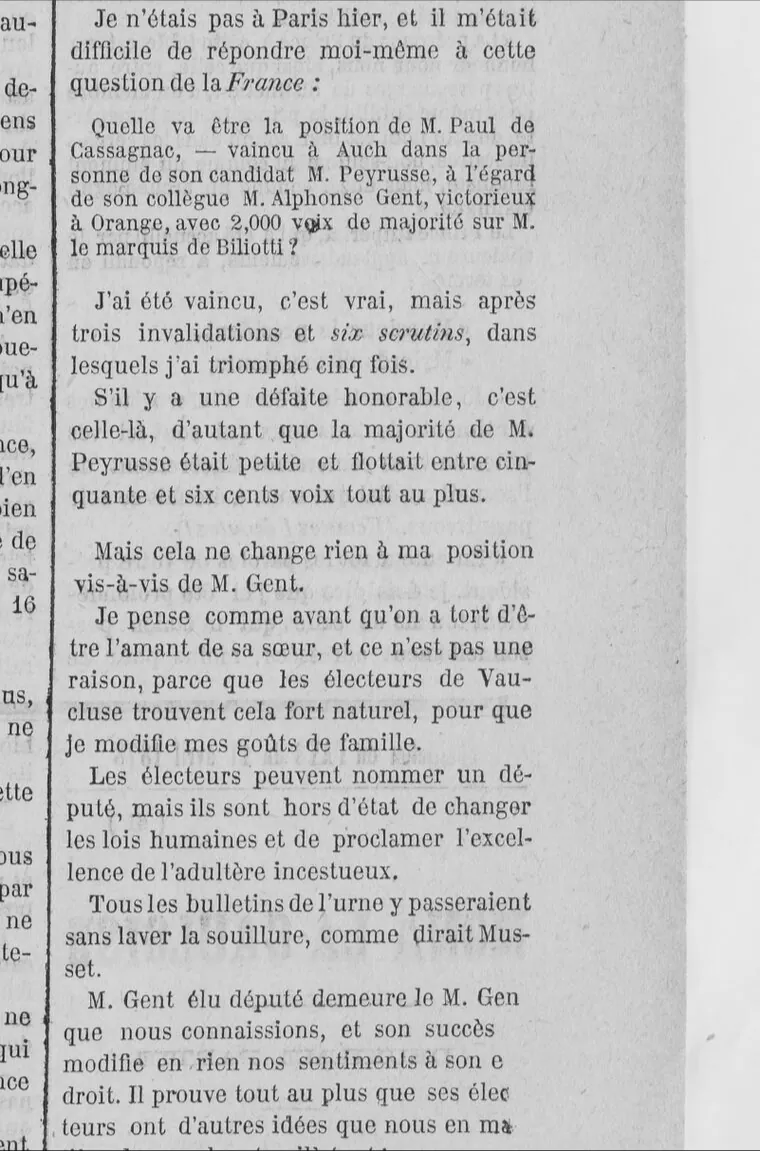
Newspaper clipping · Le Pays, 11 avril 1878, article de Paul de Cassagnac
I was not in Paris yesterday, and it was difficult for me to reply myself to this question from La France:12
Je n’étais pas à Paris hier, et il m’était difficile de répondre moi-même à cette question de la France :
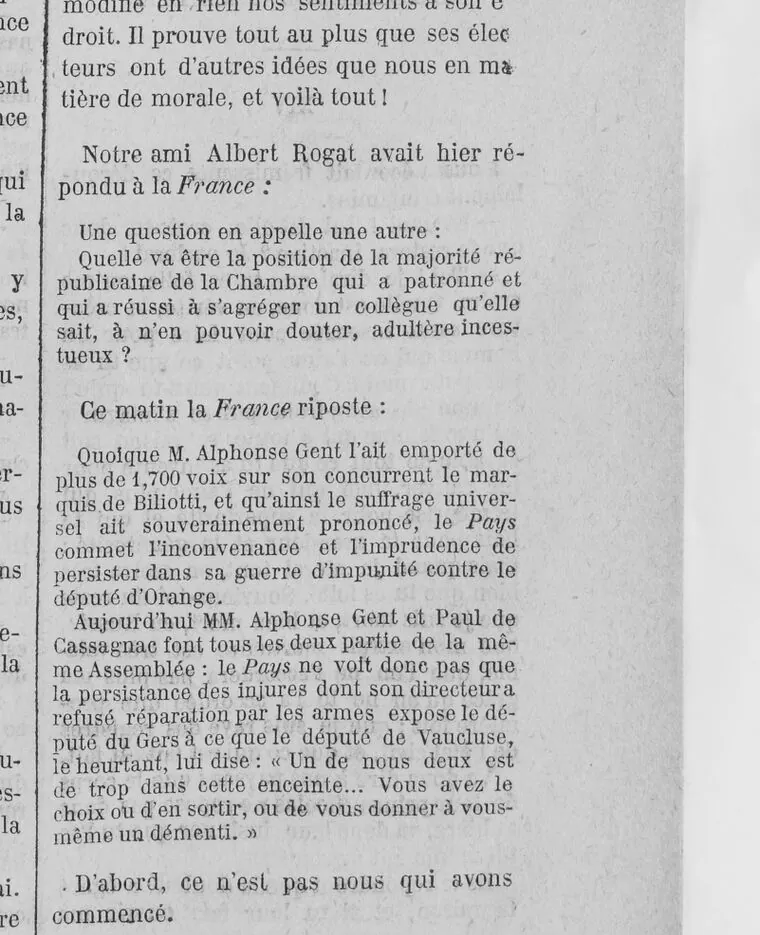
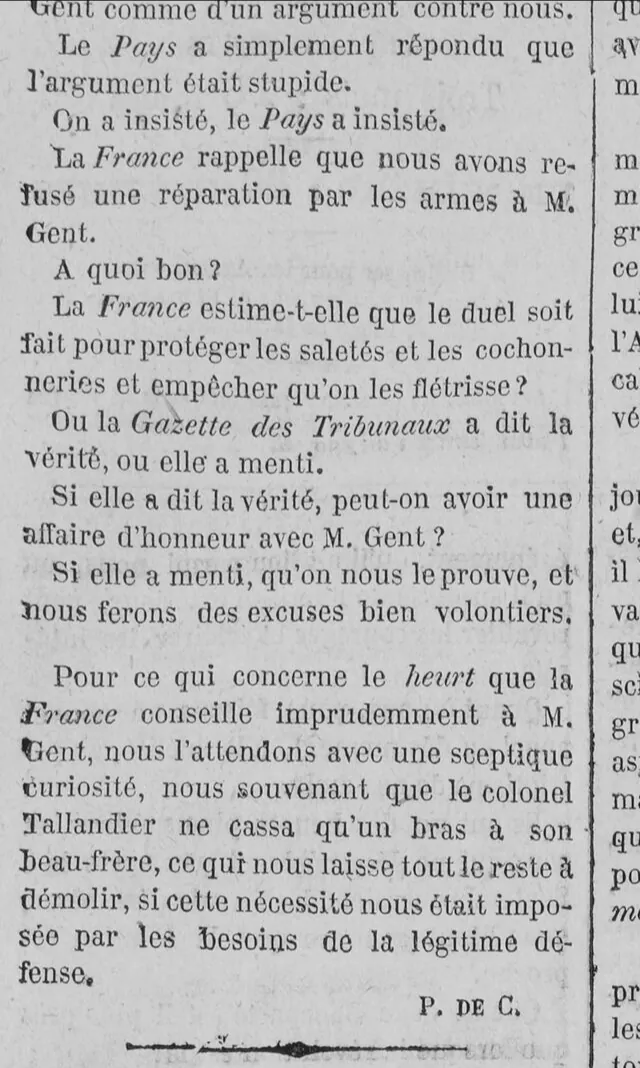
Le Pays, 11 April 1878, p. 1 — article by Paul de Cassagnac (beginning) gallica.bnf.fr / BnFLe Pays, 11 April 1878, p. 1 — article by Paul de Cassagnac (continued) gallica.bnf.fr / BnFLe Pays, 11 April 1878, p. 2 — end of Paul de Cassagnac's article, signed P. de C. gallica.bnf.fr / BnF
What will be the position of M. Paul de Cassagnac — defeated at Auch in the person of his candidate M. Peyrusse — with regard to his colleague M. Alphonse Gent, victorious at Orange with a majority of 2,000 votes over M. le Marquis de Biliotti?3
Quelle va être la position de M. Paul de Cassagnac, - vaincu à Auch dans la personne de son candidat M. Peyrusse, à l’égard de son collègue M. Alphonse Gent, victorieux à Orange , avec 2.000 voix de majorité sur M. le marquis de Biliotti ?
I was defeated, it is true, but after three invalidations and six ballots, in which I triumphed five times.
J’ai été vaincu, c’est vrai, mais après trois invalidations et six scrutins, dans lesquels j’ai triomphé cinq fois.
If there is such a thing as an honourable defeat, it is this one — the more so since M. Peyrusse’s majority was small and fluctuated between fifty and six hundred votes at most.4
S’il y a une défaite honorable, c’est celle-là, d’autant que la majorité de M. Peyrusse était petite et flottait entre cinquante et six cents voix tout au plus.
But that changes nothing in my position with regard to M. Gent.
Mais cela ne change rien à ma position vis-à-vis de M. Gent.
I think as before that it is wrong to be one’s sister’s lover, and the fact that the voters of Vaucluse find this quite natural is no reason for me to modify my family tastes.
Je pense comme avant qu’on a tort d’être l’amant de sa sœur, et ce n’est pas une raison, parce que les électeurs de Vaucluse trouvent cela fort naturel, pour que je modifie mes goûts de famille.
The voters can elect a deputy, but they are in no position to change human laws and proclaim the excellence of incestuous adultery.
Les électeurs peuvent nommer un député, mais ils sont hors d’état de changer les lois humaines et de proclamer l’excellence de l’adultère incestueux.
All the ballots in the urn could pass over it without washing away the stain, as Musset would say.
Tous les bulletins de l’urne y passeraient sans laver la souillure, comme dirait Musset.
M. Gent, elected deputy, remains the M. Gent we knew, and his success in no way alters our feelings towards him. It proves at most that his voters have different ideas from ours in matters of morality, and that is all!5
M. Gent élu député demeure le M. Gent que nous connaissions, et son succès ne modifie en rien nos sentiments à son endroit. Il prouve tout au plus que ses électeurs ont d’autres idées que nous en matière de morale, et voilà tout !
Our friend Albert Rogat had replied to La France yesterday.
Notre ami Albert Rogat avait hier répondu à la France.
What will be the position of the republican majority in the Chamber, which has sponsored and succeeded in admitting to its ranks a colleague whom it knows, beyond any possible doubt, to be an incestuous adulterer?
Quelle va être la position de la majorité républicaine de la Chambre qui a patronné et qui a réussi à s’agréger un collègue qu’elle sait, à n’en pouvoir douter, adultère incestueux ?
This morning La France retorts: “Although M. Alphonse Gent won by more than 1,700 votes over his opponent the Marquis de Biliotti, and universal suffrage has thus pronounced its sovereign verdict, Le Pays commits the impropriety and imprudence of persisting in its war of impunity against the deputy for Orange.7
Ce matin la France riposte; « Quoique M. Alphonse Gent l’ait emporté de plus de 1.700 voix sur son concurrent le marquis de Biliotti, et qu’ainsi le suffrage universel ait souverainement prononcé le Pays commet l’inconvenance et l’imprudence de persister dans sa guerre d’impunité contre le député d’Orange.
Today MM. Alphonse Gent and Paul de Cassagnac both belong to the same Assembly; does Le Pays not see, then, that the persistence of insults for which its director has refused satisfaction by arms exposes the deputy for the Gers to the deputy for Vaucluse confronting him and saying: “One of us two is one too many in this chamber... You have the choice either to leave it or to give yourself the lie.” To begin with, it was not we who started this. M. Gent’s election was used as an argument against us.8
Aujourd’hui MM. Alphonse Gent et Paul de Cassagnac font tous les deux partie de la même Assemblée; le Pays ne voit donc pas que la persistance des injures dont son directeur a refusé réparation par les armes expose le député du Gers à ce que le député de Vaucluse, le heurtant, lui dise: « Un de nous deux est de trop dans cette enceinte... Vous avez le choix ou d’en sortir, ou de vous donner à vous-même un démenti ». D’abord ce n’est pas nous qui avons commencé. On s’est servi de la nomination de M. Gent comme d’un argument contre nous.
Le Pays simply replied that the argument was stupid.
Le Pays a simplement répondu que l’argument était stupide.
La France recalls that we refused M. Gent satisfaction by arms.10
La France rappelle que nous avons refusé une réparation par les armes à M. Gent.
What would be the use?
A quoi bon ?
Does La France consider that the duel exists to protect filth and indecency and to prevent them from being branded?11
La France estime-t-elle que le duel soit fait pour protéger les saletés et les cochonneries et empêcher qu’on les flétrisse ?
Either the Gazette des Tribunaux told the truth, or it lied.
Ou la Gazette des Tribunaux a dit la vérité, ou elle a menti.
If it told the truth, can one have an affair of honour with M. Gent?
Si elle a dit la vérité, peut-on avoir une affaire d’honneur avec M. Gent ?
If it lied, let it be proved to us, and we shall apologise most willingly.12
Si elle a menti, qu’on nous le prouve, et nous ferons des excuses bien volontiers.
As for the confrontation that La France imprudently urges upon M. Gent, we await it with sceptical curiosity, remembering that Colonel Tallandier broke only one of his brother-in-law’s arms, which leaves us all the rest to demolish, should that necessity be forced upon us by the needs of legitimate self-defence. P. de C.13
Pour ce qui concerne le heurt que la France conseille imprudemment à M. Gent, nous l’attendons avec une sceptique curiosité, nous souvenant que le colonel Tallandier ne cassa qu’un bras à son beau-frère, ce qui nous laisse tout le reste à démolir, si cette nécessité nous était imposée par les besoins de la légitime défense. P. de C.
I trembled like a leaf when I saw him approach the carriage; it was as though I had fifty thousand things to reproach myself for where he was concerned; then, as we talked, I rather forgot this fear. He arrived at eight this morning. “I am worn out!”
Je tremblais comme une feuille quand je l’ai vu s’approcher de la voiture; c’est comme si j’avais cinquante mille choses à me reprocher vis-à-vis de lui; puis en parlant j’ai un peu oublié cette peur. Il est arrivé depuis ce matin huit heures. Je suis rompu !
The fact is he looked quite ravaged. Small wonder — I, who am neither a man nor French, was strangely surprised by the election of M. Gent. It is a disgrace even for the republicans themselves. One may be a republican, but more decently. And above all the six ballots for M. Peyrusse. But never mind — none of that prevents my dear great man from having the skin of his neck in poor condition. I hope that the Paris air and the attentions of his dear Swedish wife will set all that right. I arrived at the atelier all smiles — think of it, I was thinking of him at the very moment I met him.
Le fait est qu’il avait l’air bien ravagé. Il y a de quoi, moi qui ne suis ni homme ni Française j’ai été étrangement surprise par l’élection de M. Gent. C’est une saleté pour les républicains eux-mêmes. On pourrait être républicains, mais plus proprement. Et puis et surtout les six scrutins pour M. Peyrusse. Enfin ! tout cela n’empêche pas que mon cher grand homme n’ait la peau du cou en mauvais état. J’espère que l’air de Paris et les soins de sa chère femme suédoise arrangeront tout cela. Je suis arrivée à l’atelier toute riante, songez-donc j’y pensais au moment où je l’ai rencontré.
Second anatomy lesson. M. Angé evidently respects me; it is to me that he principally addresses himself and to me that he hands the plates, the bones, etc.
Seconde leçon d’anatomie. M. Angé me respecte sans doute, c’est à moi qu’il s’adresse principalement et c’est à moi qu’il donne les planches, les os, etc.
Berthe, who had gone out walking with her sister and Dina, ran off with Lancaster. She went into a shop asking them to wait and slipped out by another door.
Berthe qui était allée se promener avec sa sœur et Dina s’est enfuie avec Lancaster. Elle est entrée dans un magasin en priant de l’attendre et elle a filé par une autre porte.
I foresaw it — that repulsive man was bound to sully her.
Je le prévoyais, cet homme dégoûtant devait la salir.
Mme Yorke, who was privy to the secret and had only invited Dina to have a witness of her supposed innocence, is a little woman honest at heart perhaps, but dissolute on the surface and with no more principles than she has lovers. She and their elder sister — a well-bred and proper14 young lady and a woman of feeling — hurried here around six o’clock to reassure Dina on behalf of Mme Boyd and to beg us to keep the matter quiet.
Madame Yorke qui était dans le secret et qui n’avait invité Dina que pour avoir un témoin de sa prétendue innocence est une petite femme honnête au fond peut-être mais dissolue à la surface et sans plus de principes que d’amants. Elle et leur sœur aînée qui est une demoiselle bien élevée et comme il faut et une femme de cœur, sont accourues ici vers six heures pour rassurer Dina de la part de Mme Boyd et pour nous prier de taire l’affaire.
I do not suppose it is pleasant not to recover the innocent child until the following day... Provided he agrees to marry her now. I tell you he is a vile man! I only caught a glimpse of him once — he is a vile man.
Je ne suppose pas qu’il soit agréable de ne retrouver la candide enfant que le lendemain... Pourvu qu’il consente à l’épouser maintenant. Je vous dis que c’est un vilain homme ! Je ne l’ai entrevu qu’une fois, c’est un vilain homme.
Let a girl fall — but what I hate is the recriminations, the tears afterwards. Either abstain, or frankly accept the situation and do not complain. It is base, it is squalid, it is revolting! He does not love you enough to marry you, and if you dare to love him knowing that, it is no longer love — it is bestiality. [Several words crossed out] Love resists forgetfulness, betrayal; but its delicacy, its divinity cannot withstand this species of incomplete, pitiable, base sentiment that this man has for you.
Qu’une fille tombe, mais ce que je hais ce sont ses récriminations, ses larmes ensuite. Ou bien abstenez-vous ou bien acceptez franchement la position et ne vous plaignez pas. C’est bas, c’est sale, c’est dégoûtant ! Il ne vous aime pas assez pour vous épouser et si vous osez l’aimer sachant cela ce n’est plus de l’amour c’est de la bestialité. [Quelques mots cancellés] L’amour résiste à l’oubli, à la trahison mais sa délicatesse, sa divinité ne peut pas résister à cette espèce de sentiment inachevé, pitoyable, bas que cet homme a pour vous.
I went to see Mouzay before her guests had arrived; she receives on Wednesdays. I really behave like Cassagnac — she does everything for me and I do not even show her common courtesies. I had to go and I went. What a warm welcome — those excellent creatures take me seriously, they truly believe me to be something superior. I ate a bar of their chocolate and read them the article from Le Pays.
Je suis allée voir Mouzay avant que son monde ne fût arrivé; elle reçoit les mercredi. Je me conduis vraiment en Cassagnac, elle fait tout pour moi et je ne lui fais même pas de politesses. Il fallait aller et je suis allée. Quel bon accueil, ces excellentes créatures me prennent au sérieux, me croient vraiment quelque chose de supérieur. Je leur ai mangé une tablette de chocolat et lu l’article du « Pays. »
The observation I made on Monday about Multedo’s nose is correct. Moreover he must have a dreadful character.
La réflexion que j’ai faite lundi sur le nez de Multedo est juste. Au surplus il doit avoir un affreux caractère.
Notes
Le Pays, Thursday 11 April 1878, pp. 1–2 — read the issue on Gallica (BnF). The article, signed P. de C. (Paul de Cassagnac), answers La France on the election of Alphonse Gent as deputy for Orange.↩
Corrected from Le Pays (11 April 1878, p. 1, col. 6); the printed edition (Mon Journal t. 11) reads «il m’était difficile de répondre à cette question de la France.»↩
Corrected from Le Pays (11 April 1878, p. 1, col. 6); the printed edition (Mon Journal t. 11) reads «le marquis de Bilioni».↩
Corrected from Le Pays (11 April 1878, p. 1, col. 6); the printed edition (Mon Journal t. 11) reads «six cent voix».↩
Corrected from Le Pays (11 April 1878, p. 1, col. 6); the printed edition (Mon Journal t. 11) reads «le M. Gent que nous connaissons» and «en matière de morale et voilà tout.»↩
Corrected from Le Pays (11 April 1878, p. 1, col. 6); the printed edition (Mon Journal t. 11) reads «Une question en appel une autre».↩
Corrected from Le Pays (11 April 1878, p. 1, col. 6); the printed edition (Mon Journal t. 11) reads «l’impudence de persister».↩
Corrected from Le Pays (11 April 1878, p. 1, col. 6, and p. 2, col. 1); the printed edition (Mon Journal t. 11) reads «font tous deux partie», «le Pays ne voit donc pas que le député du Gers à ce que…» (the words «la persistance des injures dont son directeur a refusé réparation par les armes expose» are missing, which leaves the sentence incomplete) and «ou de donner à vous-même un démenti».↩
Corrected from Le Pays (11 April 1878, p. 2, col. 1); the printed edition (Mon Journal t. 11) reads «On a insisté !»↩
Corrected from Le Pays (11 April 1878, p. 2, col. 1); the printed edition (Mon Journal t. 11) ends the sentence without a full stop.↩
Corrected from Le Pays (11 April 1878, p. 2, col. 1); the printed edition (Mon Journal t. 11) reads «qu’on les flétrisse !»↩
Corrected from Le Pays (11 April 1878, p. 2, col. 1); the printed edition (Mon Journal t. 11) reads «Si elle a menti qu’on nous le prouve, et nous ferons des excuses bien volontiers ?»↩
Corrected from Le Pays (11 April 1878, p. 2, col. 1); the printed edition (Mon Journal t. 11) reads «la légitime défence» and the signature «P.de G».↩