We invent a whole story about la Righi in a blue velvet outfit with mother-of-pearl buttons, a Henri III cap with a white feather, dancing at fairs, and sending a poodle to collect sous in a bowl held in its teeth. The poodle is Monsieur the Count.
Nous inventons toute une histoire sur la Righi en habit de velours bleu à boutons de nacre, toque Henri III à plume blanche, dansant aux foires et envoyant un caniche pour ramasser des sous dans une écuelle qu’il tient entre ses dents. Le caniche, c’est Monsieur le comte.
The Gatowskys (and not Holowskys) and Olga Hamontoff being with us, I contrive an excursion on foot to the Skating, where little Santasiglia takes me round with his excellent smile. But it seemed to me the others were laughing at me.
Les Gatowsky (et non Holowsky) et Olga Hamontoff étant chez nous, j’invente une excursion au Skating à pied, ou le petit Santasiglia me promène avec son excellent sourire. Mais il me semblait que les autres se moquaient de moi.
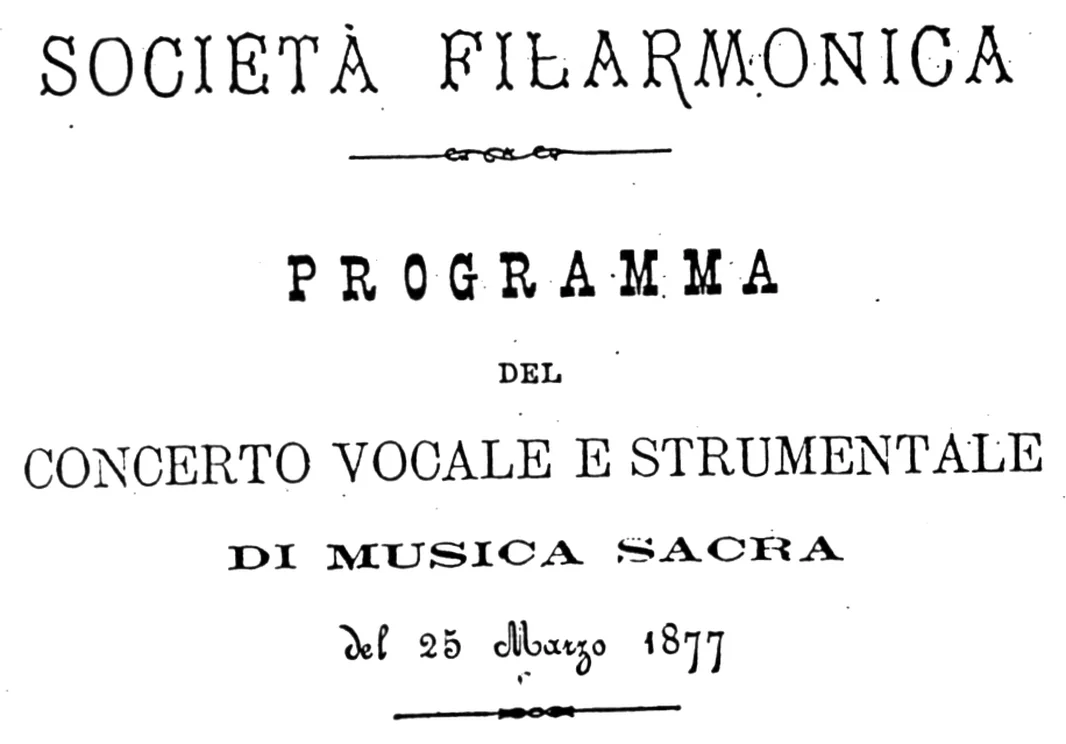
This evening, a concert at the Filarmonica; here is the programme.
Ce soir concert à la Filarmonica dont voici le programme.
I do my hair as usual and put on a white satin dress entirely covered in striped oriental gauze lightly threaded with gold, low-cut to a point front and back, short sleeves. Simply edged with blonde lace matching the fabric. Fitted at the waist by a belt with a simple gold buckle; the dress is cut in one piece and extremely long. Too “dreamy” to put me at my ease —
Je me coiffe comme d’habitude et met une robe de satin blanc entièrement couverte de gaze rayée orientale lamée légèrement d’or, décolletée en pointe devant et derrière, manches courtes. Simplement bordée de blonde assortie à l’étoffe. Serrée à la taille par une ceinture à simple boucle d’or; la robe est entière et extrêmement longue. Trop « rêve » pour me mettre à mon aise
Newspaper clipping · Programme du concert de musique sacrée, Società Filarmonica, Naples, 25 mars 1877 · in Italian
PHILHARMONIC SOCIETY PROGRAMME OF THE VOCAL AND INSTRUMENTAL CONCERT OF SACRED MUSIC of 25 March 18771
SOCIETÀ FILARMONICA PROGRAMMA DEL CONCERTO VOCALE E STRUMENTALE DI MUSICA SACRA del 25 Marzo 1877
Printed programme of the sacred music concert of the Società Filarmonica, Naples, 25 March 1877 (title page) Mon Journal, vol. 10, p. 43 (facsimile)
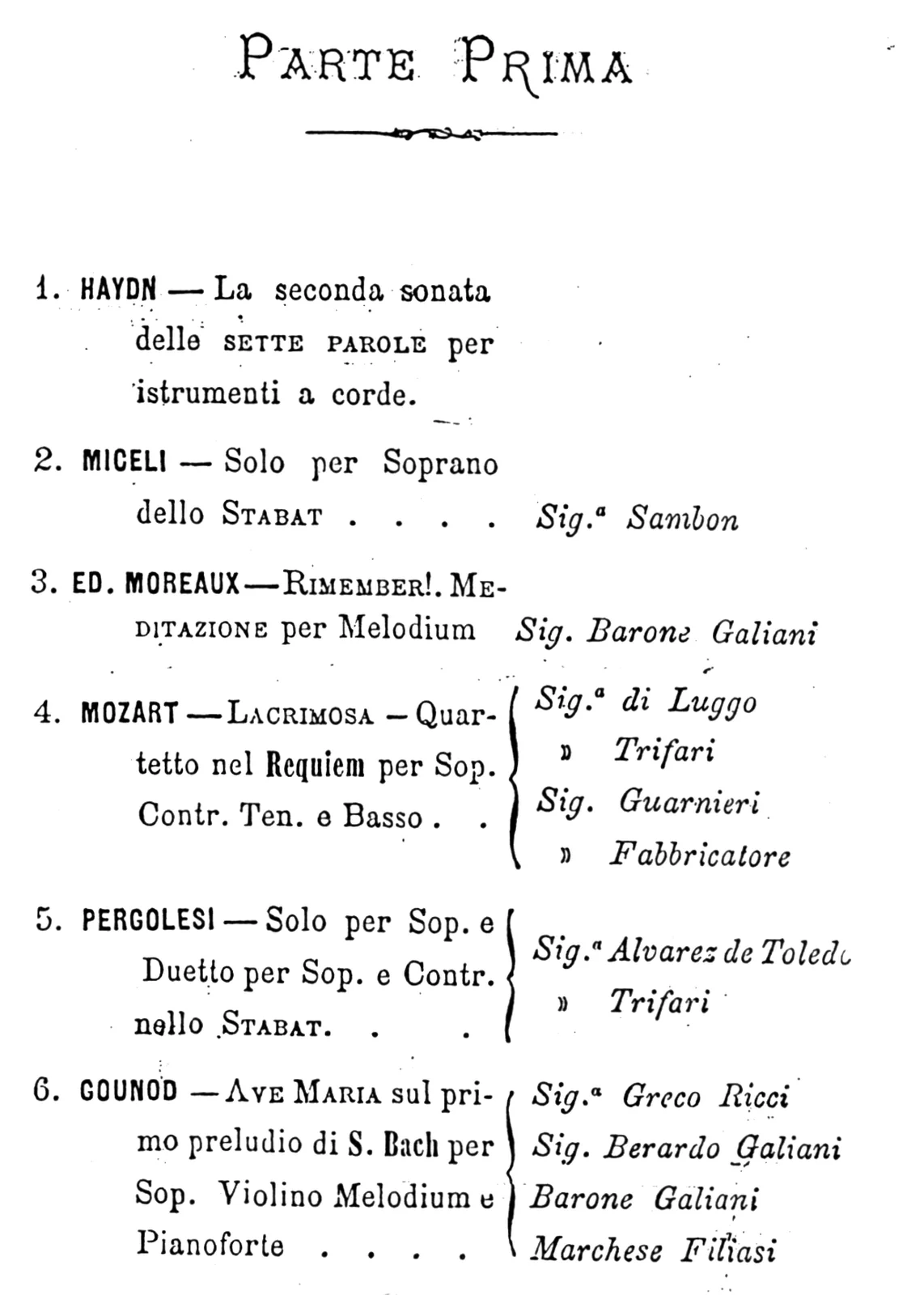
PART ONE 1. HAYDN — The second sonata of the Seven Words, for string instruments. 2. MICELI — Soprano solo from the Stabat — Signora Sambon 3. ED. MOREAUX — Rimember! Meditation for melodium — Baron Galiani 4. MOZART — Lacrimosa — Quartet from the Requiem for soprano, contralto, tenor and bass — Signora di Luggo, Signora Trifari, Signor Guarnieri, Signor Fabbricatore 5. PERGOLESI — Soprano solo and duet for soprano and contralto from the Stabat — Signora Alvarez de Toledo, Signora Trifari 6. GOUNOD — Ave Maria on the first prelude of S. Bach, for soprano, violin, melodium and pianoforte — Signora Greco Ricci, Signor Berardo Galiani, Baron Galiani, Marquis Filiasi
PARTE PRIMA 1. HAYDN — La seconda sonata delle Sette parole per istrumenti a corde. 2. MICELI — Solo per Soprano dello Stabat — Sig.ª Sambon 3. ED. MOREAUX — Rimember!. Meditazione per Melodium — Sig. Barone Galiani 4. MOZART — Lacrimosa — Quartetto nel Requiem per Sop. Contr. Ten. e Basso — Sig.ª di Luggo, » Trifari, Sig. Guarnieri, » Fabbricatore 5. PERGOLESI — Solo per Sop. e Duetto per Sop. e Contr. nello Stabat — Sig.ª Alvarez de Toledo, » Trifari 6. GOUNOD — Ave Maria sul primo preludio di S. Bach per Sop. Violino Melodium e Pianoforte — Sig.ª Greco Ricci, Sig. Berardo Galiani, Barone Galiani, Marchese Filiasi
Printed concert programme, first part Mon Journal, vol. 10, p. 44 (facsimile)
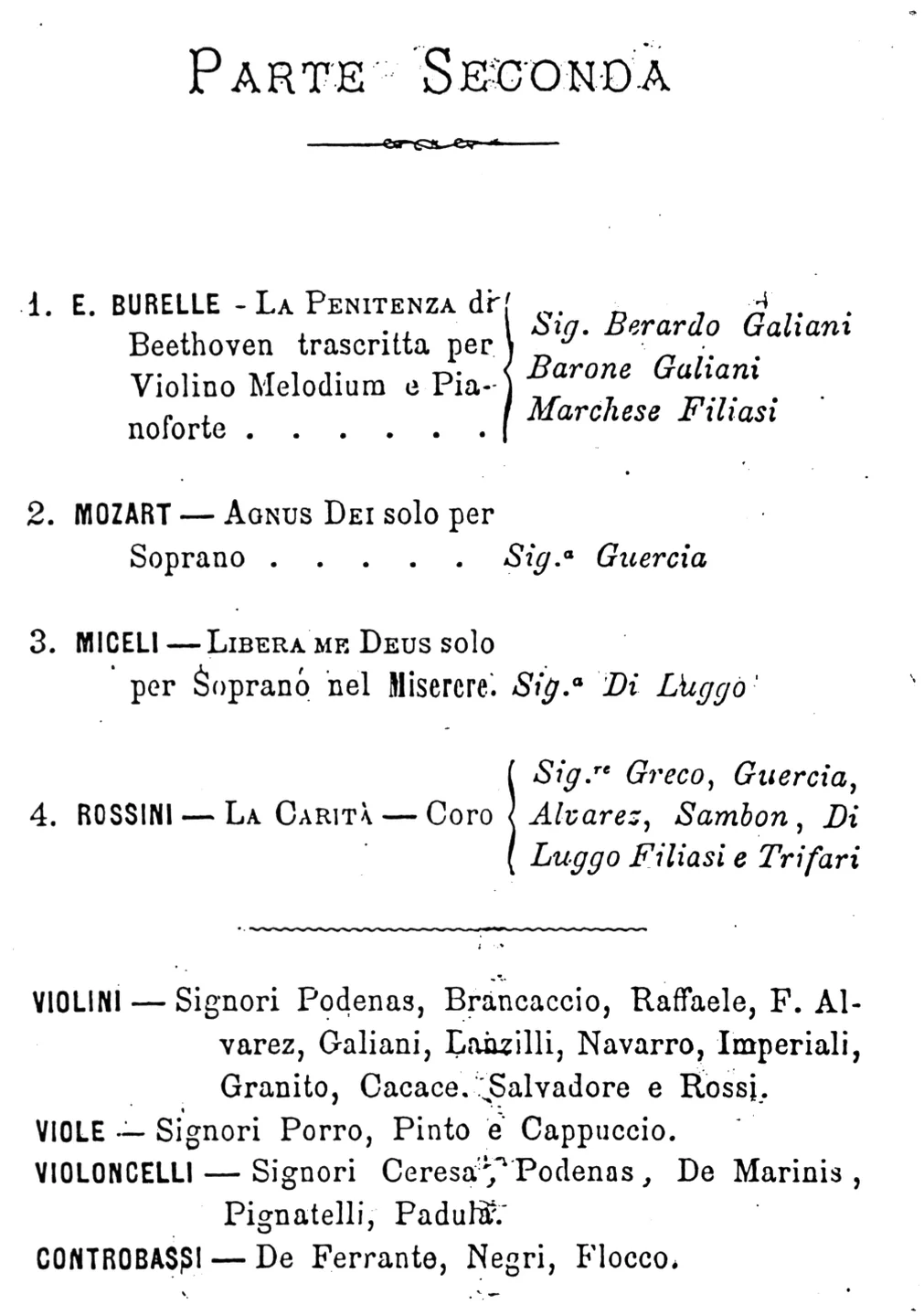
PART TWO 1. E. BURELLE — Beethoven’s La Penitenza, transcribed for violin, melodium and pianoforte — Signor Berardo Galiani, Baron Galiani, Marquis Filiasi 2. MOZART — Agnus Dei, soprano solo — Signora Guercia 3. MICELI — Libera me Deus, soprano solo from the Miserere — Signora Di Luggo 4. ROSSINI — La Carità — Chorus — Signore Greco, Guercia, Alvarez, Sambon, Di Luggo Filiasi and Trifari VIOLINS — Signori Podenas, Brancaccio, Raffaele, F. Alvarez, Galiani, Lanzilli, Navarro, Imperiali, Granito, Cacace. Salvadore and Rossi. VIOLAS — Signori Porro, Pinto and Cappuccio. CELLOS — Signori Ceresa, Podenas, De Marinis, Pignatelli, Padula. DOUBLE BASSES — De Ferrante, Negri, Flocco.
PARTE SECONDA 1. E. BURELLE — La Penitenza di Beethoven trascritta per Violino Melodium e Pianoforte — Sig. Berardo Galiani, Barone Galiani, Marchese Filiasi 2. MOZART — Agnus Dei solo per Soprano — Sig.ª Guercia 3. MICELI — Libera me Deus solo per Soprano nel Miserere — Sig.ª Di Luggo 4. ROSSINI — La Carità — Coro — Sig.re Greco, Guercia, Alvarez, Sambon, Di Luggo Filiasi e Trifari VIOLINI — Signori Podenas, Brancaccio, Raffaele, F. Alvarez, Galiani, Lanzilli, Navarro, Imperiali, Granito, Cacace. Salvadore e Rossi. VIOLE — Signori Porro, Pinto e Cappuccio. VIOLONCELLI — Signori Ceresa, Podenas, De Marinis, Pignatelli, Padula. CONTROBASSI — De Ferrante, Negri, Flocco.
Printed concert programme, second part Mon Journal, vol. 10, p. 45 (facsimile)
On entering, a panic terror seized me. What if all the others were in black! In this way we arrived at the right-hand door, where the Duc de San Cesario stood; he crooked his arm and stepped towards Maman, but I, seeing nothing in the grip of a stupid agitation, made an abrupt about-turn to the left, and the others followed suit, Maman too.
En entrant une terreur panique s’empara de moi. Si toutes les autres allaient être en noir ! Nous arrivions ainsi devant la porte de droite sur laquelle se tenait le duc de San Cesario qui arrondit son bras s’avançant vers maman, mais moi qui ne voyais rien sous l’empire d’une émotion stupide, je fis un brusque demi-tour vers la gauche et les autres m’imitèrent, maman aussi.
There’s an encouraging entrance for you.
Voilà une entrée encourageante.
I felt real relief on seeing bare necks and dresses of every colour. The Fabbricatores, who were two benches away from us, signalled that there were places beside them, so I moved over with Dina. At that moment the dilettanti who made up the orchestra appeared one by one, and there rose in the hall something like a salvo of recognition and approval, a merriment, an uproar — and indeed nothing on earth could have been more charming than those faces that strove to look grave, that were proud, and that laughed. Among the singers there were a few pretty women; there were nine of them in all, I think.
J’éprouvai un véritable soulagement en voyant des cous nus et des robes de toutes les couleurs. Les Fabbricatore qui se trouvaient à deux bancs de nous faisaient des signes qu’il y avait des places auprès d’eux; j’ai donc déménagé avec Dina; en ce moment apparurent un à un les dilettanti qui composaient l’orchestre et il s’éleva dans la salle comme une salve de reconnaissance et d’approbation, une gaieté, un tapage, et c’était en effet la chose la plus charmante de la terre que ces figures qui s’efforcaient d’être graves, qui étaient fières et qui riaient. Parmi les chanteuses il y eut quelques jolies femmes, elles étaient neuf en tout je crois.
The famous Giselle was in front of me, pressing her bare, bony shoulder against Balzorano, who almost brushed her face with his and who is handsome enough to make one tremble.
La fameuse Giselle était devant moi pressant son épaule nue et décharnée contre Balzorano qui lui effleurait presque la figure et qui est beau à faire frémir.
M. Fabbricatore took part in a Mozart quartet.
M. Fabbricatore prit part dans un quatuor de Mozart.
The Duc de San Martino played the double bass.
Le duc de San Martino jouait de la contrebasse.
From time to time I turned towards Maman; she seemed displeased, and I suffered at humiliating her with my ugliness. Pascarola sat down beside me and soon introduced the Marquis di Campomarino, son of the Duc de Sanceso, and Count Caracciolo. The first is a tiny fair-haired fox with an enormous nose and a monocle; the second is somewhat tall, somewhat fat, somewhat bald, somewhat ugly, somewhat like Bruschetti. The Duc de Melito joined these gentlemen, and soon I became the centre of a group of men in whose midst I was far from ill at ease. Melito said he preferred Jeannette’s Wedding2 to “this music of Pergolesi and Mozart”.
De temps en temps je me tournais vers maman, elle me semblait mécontente et je souffrais de l’humilier par ma laideur. Pascarola se mit près de moi et bientôt me présenta le marquis di Campomarino, fils du duc de Sanceso et le comte Caracciolo. Le premier est un tout petit renard blond à nez énorme et à monocle, le second est un peu grand, un peu gras, un peu chauve, un peu laid, un peu ressemblant à Bruschetti. Le duc de Melito se joignit à ces messieurs et bientôt je devins le centre d’un groupe d’hommes au milieu duquel j’étais loin d’être mal à l’aise. Melito dit qu’il préferait “Les noces de Jeannette” à “cette musique de Pergolèse et Mozart ».
San Cesario — that is to say Campomarino — talked painting, Caracciolo mandolin, Pascarola beauty, and Fabbricatore, coming back from the platform, received my sincere compliments. Mme Fabbricatore consoled herself by saying that it was the twenty-seven million being courted. This supposition would pain me enormously if I did not remember the effect I have produced elsewhere, in places where, far from crediting me with millions, people tore me to pieces.
San Cesario, c’est-à-dire Campomarino, parla peinture, Caracciolo mandoline, Pascarola beauté, et Fabbricatore qui revenait de la scène reçut mes sincères compliments. Mme Fabbricatore se consolait en disant qu’on faisait la cour aux vingt-sept millions. Cette supposition me ferait une peine énorme si je ne me souvenais pas de mes effets ailleurs et là où loin de me prêter des millions on m’écorchait la peau.
What was delightful was that Olga Hamontoff, who was with us, assured us with saintly frankness that all these attentions were owing to people taking her for my sister and wanting to get to her. She is priceless, with her square, angular, sallow, common face with a greenish tinge — but rather fine eyes and superb black hair.
Ce qui était ravissant c’est qu’Olga Hamontoff qui était avec nous, assurait avec une sainte franchise que toutes ces assiduités étaient dues à ce qu’on la croyait ma sœur et voulait arriver à elle. Elle est impayable avec sa figure carrée, anguleuse, jaune et commune avec un reflet verdâtre mais d’assez beaux yeux et des cheveux noirs superbes.
— You are not white today, but gilt-edged, the Duc de San Cesario said to me, coming up to us in the last drawing room.
- Vous n’êtes pas blanche aujourd’hui, mais dorée sur tranches - me dit le duc de San Cesario en venant à nous dans le dernier salon.
When I was asked whether Caracciolo might be introduced, I thought it would be Caracciolo di Bello, son of the Prefect of Rome, our neighbour on the evening of the first night of Aida in Rome this winter, and I was delighted at the honour and the pleasure; the other Caracciolo is distinguished and agreeable.
Lorsqu’on m’a demandé de présenter Caracciolo, j’ai pensé que ce serait Caracciolo di Bello, fils du préfet de Rome, notre voisin le soir de la première d’ “Aida” cet hiver à Rome, et j’étais enchantée de l’honneur et du plaisir, l’autre Caracciolo est distingué et agréable.
You no doubt notice that I have not yet recovered the art of filling pages; I get tangled up, writing bores me.
Vous remarquez sans doute que je n’ai pas encore retrouvé l’art de remplir des pages, je m’embarrasse, je m’ennuie d’écrire.
At home there was a slight altercation; Maman looked displeased, I was furious. If I have grown ugly, is it my fault!!
A la maison il y eut une légère altercation, maman avait l’air mécontente, j’étais furieuse. Si je suis enlaidie, est-ce de ma faute !!
Notes
(the printed concert programme). Titles of the works are given as printed in the programme.↩