❦
Wednesday, 30 June 1875
Collignon leaves at two o’clock.Mercredi 30 juin 1875
I had the idea that I might chance to see Audiffret arrive. The train that comes in from Italy leaves again for Paris a few minutes later.
J’avais l’idée de voir par hasard arriver Audiffret. Le train qui arrive d’Italie repart dans quelques minutes pour Paris.
We — my aunt, Dina, Collignon and I — arrive ten minutes before the departure; the passengers had long since got off.
Nous, ma tante, Dina, Collignon et moi, arrivons dix minutes avant le départ, les voyageurs étaient depuis longtemps débarqués.
Next to the compartment where Collignon was, there was a sleeping coupé, and in this coupé there was a young man, and this young man leaned half his body out of the window and never took his eyes off me. I only caught a glimpse of him, but as soon as I had noticed his looks I paid no more attention to what was being said — only my lips were talking — and in spite of myself, while kissing Collignon, I looked at the man, but only once. The train stayed a few minutes more in the station, and the man did not look away. It amused me in earnest.
A côté du compartiment où était Collignon était un coupé-lit et dans ce coupé il y avait un jeune homme et ce jeune homme sortit la moitié du corps hors de la portière et ne me quitta pas des yeux. Je n’ai fait que l’entrevoir mais dès que j’eus remarqué ses regards je ne prêtai plus aucune attention à ce qu’on disait, mes lèvres seules parlaient, et malgré moi tout en embrassant Collignon je regardai l’homme, mais une fois seulement. Le train resta encore quelques minutes en gare et l’homme ne détourna pas les yeux. Cela m’a amusé sérieusement.
The train was already moving; I walked alongside it for a few steps, talking to Collignon, and I could feel those eyes.
Le train marchait déjà, je le suivis pendant quelques pas en parlant à Collignon et je sentais ces yeux.
Everyone noticed it, and at table they say so out loud.
Tout le monde a remarqué cela et on le dit tout haut à table.
Then he ought to have stayed, says Maman.
Il faudrait qu’il reste alors, dit maman.
Oh! that would have been a romance, and romances do not happen to me.
Oh ! c’eut été un roman et les romans ne m’arrivent pas.
And why should they not happen to me?
Et pourquoi ne m’arriveraient-ils pas ?
I go to the baths and bathe; I dive, I jump, I do everything I know how to do.
Je vais au bain et me baigne, je plonge, je saute, je fais tout ce que je sais faire.
My aunt is quite surrounded by Bihovetz, Smirnoff, Enoteas and Walitsky.
Ma tante est tout entourée de Bihovetz, Smirnoff, Enotëas et Walitsky.
Collignon has gone, and Papa shouts and rages at all of us.
Collignon est partie et papa hurle et se fâche contre nous tous.
An old story.
Vieille histoire.
The windows of the château have deceived me again. They were open, as though someone had arrived. I thought I should be more bored without that scamp.
Les fenêtres du château m’ont encore trompée. Elles étaient ouvertes et comme si on était arrivé. Je croyais que je m’ennuierai davantage sans ce garnement.
I have not been any more bored than usual in Nice; I have hardly felt the absence of the handsome Niçois.
Je ne me suis pas ennuyée plus que d’habitude à Nice, j’ai à peine senti l’absence du beau Niçois.
How displeased he would be to know it!
C’est lui qui serait mécontent de le savoir !
written across the page
That is not true.
en travers Ce n’est pas vrai.
My uncle does not come! It would have been better to say he was not coming; at least we would know what to do!
Mon oncle n’arrive pas ! Il aurait mieux valu dire qu’il ne viendrait pas, on saurait comment faire au moins !
Ah! these Babanines, what disorderly people!
Ah ! ces Babanine, gens de désordre !
Paul writes that they are expecting me. I am bored, I want to go.
Paul écrit qu’on m’attend, je m’ennuie, je veux aller.
I have designed some dresses that now have to be made up, and it is a bother.
J’ai inventé des robes qu’il faut exécuter, qui me dérangent.
I have put on a jacket1 of Maman’s from when she was sixteen, twenty-two years ago. It is a grey Louis XIV jacket in dark red velvet embroidered with gold.
J’ai mis une casaque de maman quand elle avait seize ans, il y a de cela vingt-deux ans. C’est une casaque grise Louis XIV en velours rouge foncé brodée d’or.
It fits me like a glove and is still fresh.
Elle me va comme un gant et est encore fraiche.
What an admirable figure my mother had!
Quelle admirable taille ma mère avait !
Yes, she was very beautiful; she would be beautiful and shapely still if illness had not treated her so cruelly. She can neither wear a corset nor do her hair, and lately she has been quite worn out and ill and to be pitied.
Oui, elle était bien belle, elle serait belle et bien faite encore maintenant si les maladies ne l’avaient tant maltraitée. Elle ne peut ni mettre un corset, ni se coiffer, et ce dernier temps est toute défaite et malade et à plaindre.
I have sewn a lace ruff on to this jacket, which is open in front; nothing could be whiter than my skin, and I look admirable in it.
J’ai cousu une fraise de dentelle à cette casaque ouverte devant, rien de plus blanc que ma peau et je suis admirable ainsi.
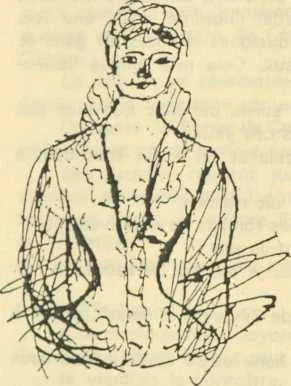
I do believe the women of those days were beautiful. With my face one would have passed for a beauty, and a beauty passed for a goddess!
Je crois bien que les femmes d’alors étaient belles. Avec ma figure on passait pour une beauté et une beauté passait pour une déesse !
That velvet, those open necklines, that lace, those long, close-fitting waists that set off a woman’s figure, those long gowns and rich fabrics, those coiffures, so poetic. Not the ugly heads of today, all the hair gathered up in ugly little curls, or all scraped up — in a word, ugly.
Ce velours, ces gorges ouvertes, ces dentelles, ces tailles longues et ajustées qui font valoir la femme, ces robes longues et ces riches étoffes, ces coiffures si poétiques. Ce n’est pas la vilaine tête d’à présent, tous les cheveux ramassés en vilaines petites boucles, ou tout ramassés, en un mot vilainement.
Dina interrupts me to show me Audiffret’s window, lit up, and from my dark study, with an opera glass, we see a man at the window with both arms raised as if holding an opera glass. It would have been funny if he had been doing what we were doing.
Dina m’interrompt pour me montrer la fenêtre d’Audiffret éclairée et de mon cabinet sombre avec un binocle nous voyons un homme à la fenêtre avec les deux bras en l’air comme tenant un binocle, c’eut été drôle s’il faisait ce que nous faisons.
Only nobody can see us; we are in the dark.
Seulement nous on ne nous voit pas, nous sommes dans l’obscurité.
Notes
In French in the original: casaque — a loose jacket or bodice; this one, Maman’s from her girlhood, is open in front. ↩