❦
Saturday, 3 October 1874
Samedi, 3 octobre 1874
I take a walk with the dogs and without a hat, as far as Villa 77, in the morning.
Je fais une promenade avec les chiens et sans chapeau, jusqu’à la villa 77 le matin.
I do not go out but stay all day at Maman’s, where the excavations continue.
Je ne sors pas, mais reste toute la journée chez maman où on continue les excavations.
They talk about the furniture — badly, no doubt; Maman especially.
On parle des meubles, mal sans doute, maman surtout.
Walitsky is always inventing some nonsense; he never stops sending letters to Makaroff, who is each time very disturbed and comes running to ask Papa’s advice.
Walitsky invente toujours quelque bêtise, il ne cesse d’envoyer des lettres à Makaroff qui est chaque fois très troublé et accourt demander des conseils à papa.
It is Ogarev, the socialist, who writes, and this time treats him as a friend, telling him that in a fit of anger he bit Turgenev on the ear. That fool believes everything and makes us laugh. In these letters there are verses, composed by supposed enemies of Makaroff, in which he is regarded as a conspirator and writer against the Russian government, et cetera, et cetera.
C’est Ogareff, le socialiste, qui écrit et cette fois le traite en ami, et lui dit que, dans un accès d’irritation, il a mordu Tourguenieff à l’oreille. Cette bête croît à tout et nous fait rire. Dans ces lettres il y a des vers, faits par des soit-disant ennemis de Makaroff, où il est considéré comme conspirateur et écrivain contre le gouvernement russe etc. etc.
I go to bed, followed by Maman and my aunt. But as soon as I am in my room, I do not know how the conversation falls upon the villa, and I begin to lament the loss of my pavilion. I have never ceased to lament over this, but tonight the lamentations changed into sobs, into tears, into bitter, heartrending complaints.
Je vais me coucher, suivie de maman et de ma tante. Mais aussitôt chez moi, je ne sais plus comment la conversation tombe sur la villa, et je me mets à me lamenter de l’enlèvement de mon pavillon, je n’ai jamais cessé de me lamenter pour cela mais ce soir les lamentations se changèrent en sanglots, en larmes, en plaintes sanglantes et déchirantes.
I weep, not for the pavilion — because I no longer care for it — but because they have turned me from it, disgusted me with it.
Je pleure, non pour le pavillon parce que je n’y tiens plus, mais parce qu’on m’en a détournée, dégoûtée.
Silk dresses from Garach and ribbon bows do not interest me, as they interest the Howards and the like. Few things please me, and these few things always consist of great things. This villa, this pavilion, pleased me from the first day, and I made a thousand plans in my head — how they would be furnished, how my study would be downstairs, my chambermaid close at hand, my bedroom with its balcony, its two terraces, its view over the Promenade and the sea, its five windows, its little entrance where my shell-shaped bath was to go — all of this pleased me and amused me. Now they have spoilt everything, ruined everything! I know very well I can, if I wish, do as I wanted — but I no longer want to. They have disgusted me with it, they have arranged things so that I no longer want it, that I no longer know what, but that I would not take those other rooms if they forced me, and it is for this that I weep.
Les robes de soie de Garach et les nœuds de rubans ne m’intéressent pas, comme ils intéressent les Howard etc. peu de choses me plaisent, et ces peu de choses consistent toujours en de grandes choses. Cette villa, ce pavillon, dès le premier jour me plurent et je faisais dans ma tête mille plans, comment on les meublera, comment mon étude sera en bas, ma femme de chambre tout près; ma chambre avec son balcon, ses deux terrasses, sa vue sur la Promenade et la mer, ses cinq fenêtres, sa petite entrée où devait être mon bain coquille, tout cela me plaisait et m’amusait. Maintenant on a tout gâté, tout abîmé ! je sais bien que je puis si je veux faire comme je voulais mais je ne veux plus, on m’a dégoûtée, on a posé cela de sorte que je n’en veux plus, que je ne sais plus quoi, mais que je ne prendrais plus ces autres chambres si on me forçait de les prendre, et c’est pour cela que je pleure.
I weep no longer not because they have overturned, disturbed, and ruined all my plans, but because they have disenchanted me, because I no longer want it, because they have disgusted me and turned me from all of it, and because I am forced to recognise that they can thus ruin what I desire — by words said the wrong way, and by the smallest things.
Je ne pleure plus pas parce qu’on a renversé, dérangé, abîmé tous mes projets mais parce qu’on m’a désenchantée, parce que je n’en veux plus, parce qu’on m’a dégoûtée et détournée de tout cela et parce que je suis forcée de reconnaître qu’on peut ainsi m’abîmer ce que je désire, par des paroles dites de travers, et par les moindres choses.
I weep because they have contrived it so that I no longer want, despite the most my great desire, to have what I wanted.
Je pleure parce qu’on a fait de sorte que je ne veux plus, malgré le plus mon grand désir, avoir ce que je voulais.
Seeing me so desperate — for I am so desperate that I want refuse to cancel at Duval’s — seeing me so desolate, they will come and offer to dislodge everyone. (I was obliged to throw down the pen to weep! Have mercy, have mercy, have mercy!1) But I no longer want anything, I want nothing. I shall not speak of the horse for fear they ruin it for me. I am foolish, but that is how it is!
Me voyant aussi désespérée, car je suis tellement désespérée, que je veux refuse décommander chez Duval, me voyant si désolée, on viendra m’offrir de déloger tout le monde, (j’étais obligée de jeter la plume pour pleurer ! Triple Miséréré ! mais je ne veux plus rien, je ne veux rien. Je ne parlerai pas du cheval de peur qu’on ne me l’abîme, je suis bête mais c’est ainsi !
They can make me uncertain with a single unkind word! They poison all my pleasures and then give them to me. Those wretched shooting matches and races — how many tears did they cost me? In the end I went, but disgusted, disenchanted, desolate, no longer wanting to look at anything, with a heavy heart, praying God the match or the race would end.
On peut me rendre incertaine par une seule parole méchante ! On m’empoisonne tous mes plaisirs et on me les donne après. Ces malheureux tirs et courses, combien de larmes m’ont-ils coûté ? à la fin j’y allais mais dégoûtée, désenchantée, désolée, ne voulant plus rien regarder et le cœur gros, et priant Dieu que le tir ou la course finisse.
What an adorable way of granting my wishes, of spoiling me!
C’est une adorable manière de faire mes volontés, de me gâter !
crossed outEverything, everything.
Now I myself no longer want those rooms; Grandpapa would be grieved too. And then to trouble him at his age, to disturb him — it is not right and I do not wish to do it. The only thing that appeals to me now is an apartment in the annex they are going to build. But when! There is no money; the furniture costs fifty thousand francs and the annex will cost as much, and then there is the furnishing.
Maintenant moi-même je ne veux plus de ces chambres, grand-papa serait chagriné lui aussi. Et puis le tracasser à son âge, le déranger, ce n’est pas bien et je ne veux pas le faire, la seule chose qui me sourit maintenant c’est un appartement dans l’annexe qu’on va faire. Mais quand ! Il n’y a pas d’argent, les meubles coûtent cinquante mille francs et l’annexe coûtera autant, et pour la meubler.
Well then! There is no money and there is no annex, so that nothing appeals to me. And on top of that, no horse, for once again there is no money.
Enfin ! Il n’y a pas d’argent et il n’y a pas d’annexe de sorte que rien ne me sourit. Et avec cela pas de cheval, car encore il n’y a pas d’argent.
Always money! I rage! Because I myself understand that there is no money and that, as I had planned to do, everything was agreed and in order and there was no need to spend, and that now everything is overturned, poisoned, poisoned, poisoned!
Toujours de l’argent ! Je rage ! Parce que je comprends moi-même qu’il n’y a pas d’argent et que, comme j’avais pensé faire, tout était bien et d’accord et il ne fallait pas dépenser et que maintenant tout est renversé, empoisonné, empoisonné, empoisonné ! '
The scene of today has by itself lost everything. One must no longer dream of the pavilion. Even as I write, I weep, I sob, and I look at myself in the mirror — a fine face indeed! Eyes swollen, nose shining, swollen, and red; cheeks wet and dulled; lips disdainful, trembling, and red as cactus blood — and over this admirable face tears flow in such abundance one could have a shower in them.
Que la scène d’aujourd’hui a par elle seule tout perdu, il ne faut plus songer au pavillon, tout en écrivant je pleure, je sanglote et me regarde dans la glace, belle face ma foi ! Yeux enflés, nez luisant enflé et rouge, joues mouillées et abruties, lèvres dédaigneuses et frémissantes et rouges comme du cactus sang, et sur cette admirable figure coulent des larmes en telle abondance qu’on pourrait prendre une douche.
I weep because I no longer want what I wanted so much, because they have disgusted me with it, because they have poisoned my pleasure. Sometimes a single contrary word poisons it for me so thoroughly, and then I no longer weep because I want what I desire, but because they have poisoned it for me and turned me away from it.
Je pleure parce que je ne veux plus de ce que je voulais tant, parce qu’on m’a dégoûtée, parce qu’on a empoisonné mon plaisir. Quelquefois une seule parole contraire m’empoisonne tant, et alors je ne pleure plus parce que je veux ce que je désire, mais parce qu’on me l’a empoisonné et que j’en suis détournée.
And today I am in despair because the pavilion is lost to me, within me. My aunt alone is good; she poisons nothing for me, she loves me, she looks after me, in deed and not in words. She has me take iron in secret, whereas others would announce it with a trumpet and glory in it! She is good to me, and for that I love her more than anyone in the world! She has just hung tulle curtains for me so that I shall not be wretchedly eaten by the mosquitoes; in Paris she had a bath brought for me, while the others only talk and proclaim me ill, dying, fainting, and I know not what else!
Et aujourd’hui je me désespère parce que le pavillon est perdu pour moi, dans moi. Ma tante seule est bonne, ne m’empoisonne en rien, m’aime, me soigne, en vérité et non sur paroles; elle me fait prendre du fer en cachette, tandis que d’autres l’annonceraient avec une trompette et s’en glorifieraient ! Elle est bonne pour moi et je l’aime pour cela plus que personne au monde ! Elle vient de m’accrocher des rideaux de tulle pour que je ne sois pas misérablement mangée par les moustiques, à Paris elle m’a fait apporter un bain, tandis que les autres parlent seulement et me proclament malade, mourante, défaillante, et que sais-je encore !
My God, forgive me if I am unjust. I say if because I am so distressed that I can no longer tell what is just and what is not. I seem to myself the most miserable of the miserable, and at the same time I think how many unfortunate people there are, truly unfortunate, beside whose misfortune my vexation is an incomprehensible folly; and then I pray God to forgive me, because I am guilty, I am capricious.
Mon Dieu pardonne-moi si je suis injuste, je dis si parce que je suis tellement désolée que je ne reconnais plus ce qui est juste et ce qui ne l’est pas. Je me semble la plus misérable des misérables et en même temps je pense combien il y a des malheureux, vraiment malheureux auprès du malheur desquels, mon désagrément est une folie incompréhensible, et alors je prie Dieu de me pardonner parce que je suis coupable, je suis capricieuse.
Forgive me, Lord!
Pardonnez-moi Seigneur !
But the annex is not the pavilion, which is so near the Promenade, which is so pretty, so graceful inside. I wanted to join my terrace to the cypress terrace by a rustic bridge, I wanted... I wanted so many things; I had thought it all out so well and pictured myself living in that pavilion.
Mais l’annexe n’est pas le pavillon qui est si près de la Promenade, qui est si gentil, si gracieux en dedans, je voulais joindre ma terrasse à la terrasse des cyprès par un pont rustique, je voulais... je voulais tant de choses, j’ai si bien pensé et imaginé moi-même demeurant dans ce pavillon.
Losing it is for me like losing the Duke of Hamilton; it is very nearly the same grief.
Sa perte pour moi est comme la perte du duc de Hamilton, c’est un chagrin à peu près pareil.
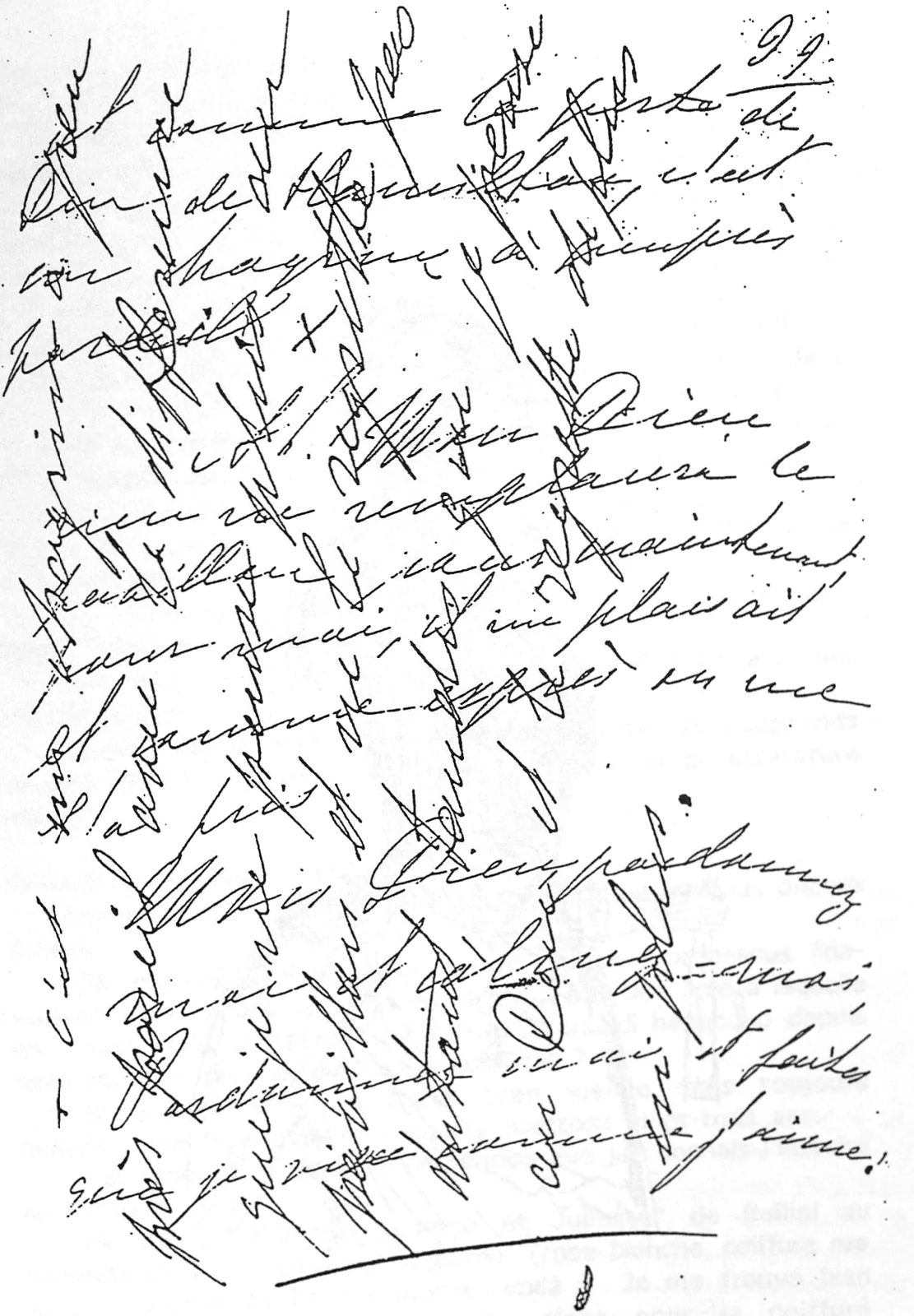
Ah, my God, nothing will replace the pavilion for me, not now. I liked it, and they took it from me as if on purpose.
Ah ! mon Dieu, rien ne remplacera le pavillon pour maintenant, pour moi, il me plaisait et comme exprès on me l’a pris.
written across the page
It is very nearly the same grief, with the difference that I no longer think of the pavilion and do not regret it at all, whereas I think of the Duke and regret him more and more.
en travers C’est un chagrin à peu près pareil, avec la différence que je ne pense plus au pavillon et ne le regrette pas du tout, tandis que je pense au duc et le regrette de plus en plus.
Forgive me, my God, and calm me. Forgive me, and grant that I may live as I like!
Mon Dieu pardonnez-moi et calmez-moi. Pardonnez-moi et faites que je vive comme j’aime !
Notes
In the original: Triple Miséréré ! — the Latin Miserere (“Have mercy!”), opening word of Psalm 51, which she “triples” for emphasis. ↩