❦
Tuesday, 28 September 1880
Mardi 28 septembre 1880
A good day, begun in the night. I dreamed of Cassagnac. He was plain and unwell — but that does not matter. I understand now that one does not love for beauty. We were talking like two friends, as before; as we would talk again if we met! I asked only one thing: that our friendship remain within the permitted limits, so as to last. [Two lines crossed out]
Une bonne journée commencée dès la nuit. J’ai rêvé de Cassagnac. Il était laid et malade, mais ça ne fait rien. Je comprends maintenant qu’on n’aime pas pour la beauté. Nous causions comme deux amis, comme avant; comme nous causerions encore si nous nous retrouvions ! Je ne demandais qu’une chose: que notre amitié restât dans les limites permises pour durer. [Deux lignes rayées]
That was my dream in waking life too. In short, I have never been so happy as last night.
C’était aussi mon rêve dans la réalité. Enfin je n’ai jamais été si heureuse que cette nuit.
Saint-Amand arrives for lunch, full of enthusiasm over my letter, which was written like this:
Saint Amand arrive à déjeuner, dans l’enthousiasme de ma lettre ainsi écrite:
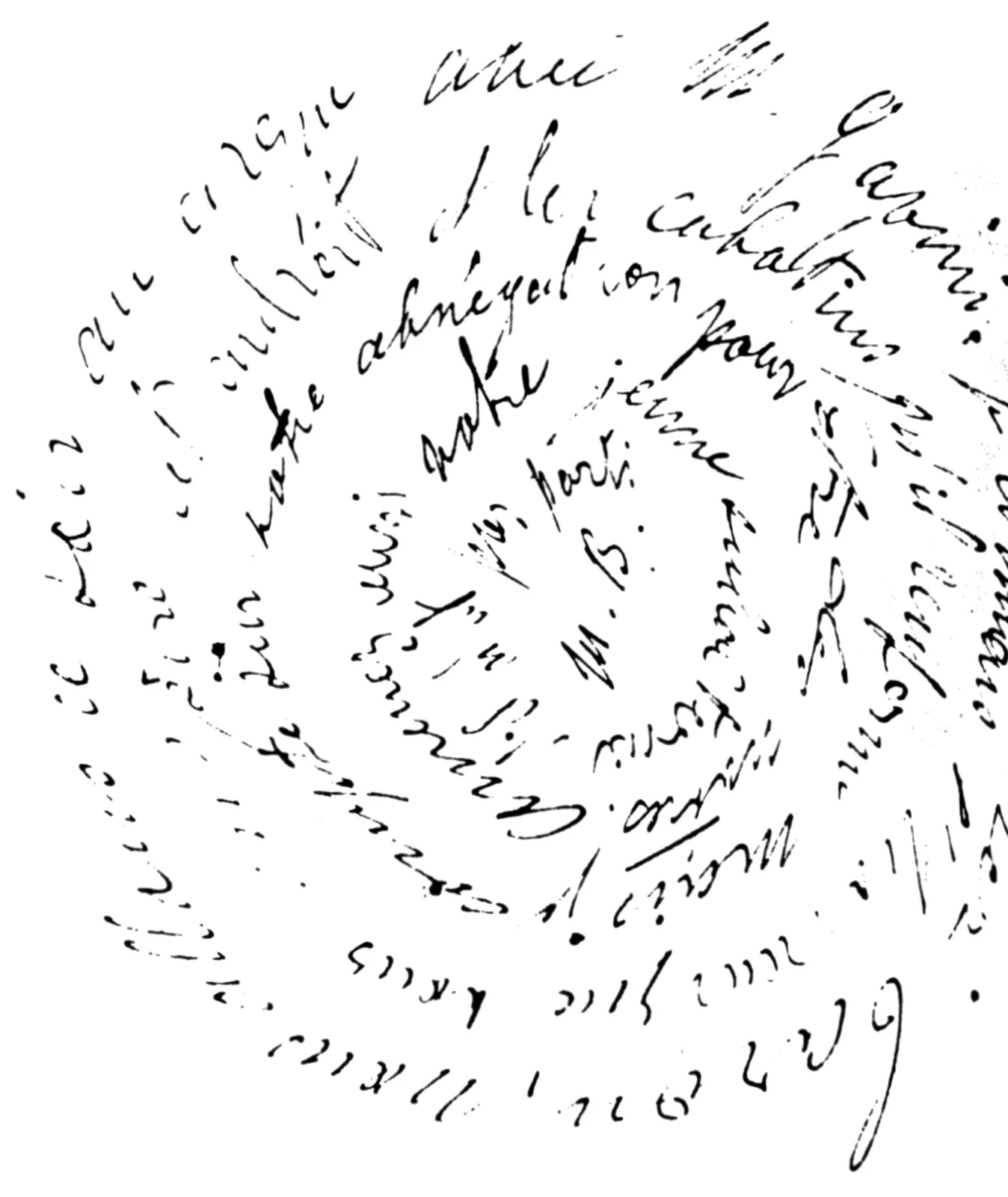
Copied letter · Lettre de Marie Bashkirtseff au baron de Saint-Amand, 28 septembre 1880, écrite en spiraleDear Baron, we are going to the circus this evening with M. Gavini. I know the horror that place and the hams it harbours inspire in you, but I am counting on your selflessness to join our party. Bring your young subordinate too, if he has not left. M.B.
Cher baron, nous allons ce soir au cirque avec M. Gavini. Je connais l’horreur que vous inspire cet endroit et les cabotins qu’il renferme mais je compte sur votre abnégation pour être des nôtres. Amenez aussi votre jeune subalterne s’il n’est pas parti. M.B.
This buffoonery earns me an avalanche of compliments — I am this and that, and this winter an élite circle will form around me; he will bring me celebrities, all the somebodies, and so on and so on! I did not even need any of that. I woke up laughing and it did not stop. Besides — see the madness of the evening. Towards half past six the bell rings: it is Saint-Amand again and Gabriel, coming to propose something mad, for the fun of it.
Cette bouffonnerie me vaut une avalanche de compliments, et je suis ceci et cela et l’on formera cet hiver un cercle d’élite autour de moi, il m’amènera des célébrités, tous les quelqu’un etc. etc. etc ! Je n’avais pas même besoin de cela, je me suis éveillée en riant et ça n’a pas cessé. Du reste, voyez la folie du soir. Vers six heures et demie on sonne, c’est Saint-Amand encore et Gabriel qui viennent proposer quelque chose de fou pour s’amuser.
Gabriel’s father is giving a dinner this evening for a few solemn Algerians, to talk over Tunisian business — they have properties there.
Le père Gabriel donne à dîner ce soir à quelques graves Algériens pour causer affaires de Tunisie où ils ont des propriétés.
Old Gavini is one of the party, and Saint-Amand too, and Gabriel had the idea of announcing two colleagues from the ministry to his father — and bringing my aunt and me instead.
Le père Gavini en est et Saint Amand aussi et Gabriel a imaginé d’annoncer à son père deux collègues du ministère et de nous amener ma tante et moi.
Imagine our arrival — old Géry suspected nothing. In short, it was delightful.
Vous vous figurez notre arrivée, le père Géry ne se doutait de rien. Enfin, ça a été ravissant.
There is Monsieur le comte de Sancy, Allégro, and a someone-or-other, an Arab; the latter was superb. He is an engineer, I believe, and on that account wished to talk to me of Latin, Greek, Horace, Livy, and so on!
Il y a M. le comte de Sancy, Allégro et un je ne sais qui, un Arabe, ce dernier a été superbe. Il est ingénieur, je crois et à ce titre a voulu me parler latin, grec, Horace, Tite-Live, etc !
“You may safely venture among your three fathers,” said Gabriel — old Gavini, old Saint-Amand and old Géry — “for my father is your father too.” He refers to me as his father’s daughter.
Vous pouvez bien vous risquer chez vos trois pères, a dit Gabriel, le père Gavini, le père Saint Amand et le père Géry, car mon père est aussi votre père, il me désigne comme la fille de son père.
That rascal Gabriel has such intonations, such words... for instance, I don’t know how he contrived to say to me:
Ce chien de Gabriel a des intonations et des mots... ainsi, je ne sais comment il s’y est pris pour me dire:
“If you wish to be adored even more than you already are by my father, tell him he has beautiful paintings.”
- Si vous voulez être encore plus adorée que vous n’êtes par mon père, dites-lui qu’il a de beaux tableaux .
It was charming. Saint-Amand is launching Gabriel — he told my aunt that if Gabriel listens to him he will have him sleeping with the most beautiful women in Paris.
C’était charmant. Saint Amand lance Gabriel, il a dit à ma tante que si Gabriel l’écoute il le fera coucher avec les plus jolies femmes de Paris.
How disgusting men are! It is not prudishness — but still...
Sont-ils dégoûtants les hommes ! Ce n’est pas pruderie, mais enfin...
To love without love! And is it nothing that we women are chaste... at least in body.
Aimer sans amour ! Et n’est-ce donc rien que nous autres femmes sommes chastes... au moins de corps.
Where is the merit of being chaste in body when one is also chaste in soul?? I have thought foolish things since childhood — but also, if I loved someone, it would be true. [Top of the page torn] It is not even counted to our credit.
Où est le mérite d’être chaste de corps lorsqu’on l’est dans son âme ?? Moi j’ai pensé des bêtises dès mon enfance mais aussi si j’aimais quelqu’un ça serait vrai [Haut de la page déchiré] Ça ne nous est même pas compté.
Gabriel brings back what I sent to Brussels — all of it preserved, along with the scrap of paper with the address of a pastry-shop that I gave him at the Opera. And my photograph is framed in a ravishing frame; he brings it for me to see, along with the penknife he gave me as a gift at the Opera. We are children. But Saint-Amand is not foolish, and lets us go out on the balcony alone, busying himself with little glasses of liqueur and covering for us. It seems he can never marry, so he busies himself with other people’s affairs... It is insane. You know those lists — parlour confessions1 — where one writes what one most values in one’s friends, one’s favourite authors, how one would wish to die, and so on.
Gabriel apporte mon envoi à Bruxelles, tout cela est conservé ainsi que le bout de papier, l’adresse d’un pâtissier que je lui ai donnée à l’Opéra. Et ma photographie est encadrée dans un cadre ravissant, il me l’apporte à voir et aussi le canif dont il m’a fait cadeau à l’Opéra. Nous sommes enfants. Mais Saint Amand n’est pas bête et nous laisse aller seuls sur le balcon, s’occupant à boire des petits verres de liqueur et nous protégeant. Il paraît qu’il ne pourra jamais se marier, alors il s’occupe des autres... C’est insensé . Vous connaissez ces listes: confidences de salon, on écrit ce que l’on préfère chez ses amis, quels sont vos auteurs favoris, comment vous voudriez mourir etc. etc.
I fill in Gabriel’s list with purities, sanctities, pieties, etc. Which allows him to venture some silly remarks that I pretend not to hear.
Je remplis la liste de Gabriel par des puretés, des saintetés, des piétés etc. Ce qui lui permet de risquer des bêtises que je fais semblant de ne pas entendre.
As for the Algerians, they adopt me — I am their daughter. Géry has already promised me an unforgettable journey in the East if we go to Algeria, and all three renew their invitations and promises.
Quant aux Algériens, il m’adoptent, je-suis leur fille. Déjà Géry m’a promis de me faire faire un voyage oriental inoubliable si nous allions en Algérie, les trois recommencent les invitations et les promesses.
I tell myself we shall have great fun, if Algeria does not turn into another Biarritz. Mr What’s-his-name — I do not know his name — was unbelievable when he said goodbye: he began by declaring that he would be a father to me in Algeria, I would be his seventh daughter. “Yes, you shall command like a queen — we shall have lions, tigers, and for transport camels, and if there are none, I shall be too happy to serve as your camel, radiant to carry on my neck so ravishing a little cocotte — I mean poulette2.” Monsieur de Sancy fled so as not to burst out laughing; I thanked him with a straight face.
Je me dis que nous nous amuserons bien si Alger ne tourne pas en Biarritz. Le mistanflûte dont je ne sais pas le nom a été inoui, en me disant adieu, il a commencé par déclarer qu’il serait pour moi en Algérie un père, je serais sa septième fille: Oui, vous commanderez en reine, nous aurons des lions, des tigres et, pour le transport des chameaux, et s’il n’y en a pas, je serai trop heureux de vous servir de chameau, radieux de porter sur mon cou une aussi ravissante petite cocotte, je veux dire poulette. Monsieur de Sancy s’enfuit pour ne pas éclater, moi j’ai remercié sérieusement.
Saint-Amand says to us: “The Crayfish” — and in the commotion... what commotion? What a style I have! No — so I cut my finger and display the bright red blood with satisfaction; Gabriel hurries to wipe it with his handkerchief, and as it continued to bleed, he took my finger and drank the blood. But on the balcony we stayed barely a minute — our flirtations might have been noticed, in spite of Saint-Amand.
Saint Amand nous dit: « Les Ecrevisses » et dans la bagarre... quelle bagarre ? J’ai un style !! Non, alors je me coupe le doigt et montre avec complaisance le sang tout rouge, Gabriel s’empresse de l’essuyer avec son mouchoir et comme il en venait encore, il me reprit le doigt et but le sang. Mais sur le balcon, nous sommes restés une minute à peine, on aurait pu remarquer nos flirtations, malgré Saint Amand.
It is funny — Gabriel and I laugh into each other’s eyes, but I take care to keep it all in the air; I don’t want to look as if I mean anything by it, and I chatter away nonstop, threading everything through with innocent glances and laughing the whole time.
C’est drôle, Gabriel et moi, nous nous rions dans les yeux, mais j’ai soin de me tenir en l’air, je ne veux pas avoir l’air d’y toucher et caquette à mort en entremêlant le tout par des regards d’innocente et en riant tout le temps.
Gabriel told me on the balcony that it was kind of me to have come, in a serious tone. And it sounded quite odd.
Gabriel m’a dit sur le balcon que j’étais gentille d’être venue, d’un ton sérieux. Et ça a sonné tout drôlement.
He picks up the rose petals I throw... a heap of childishness... He is sweet. In any case what is always true is that I laughed heartily — oh, so heartily — and that in spite of it I had a superb complexion the whole time, white, white and pink, with no sign of fatigue or flushing. It is good to laugh. Now I shall probably have to pay for this day with tears.
Il ramasse les feuilles de roses que je jette... un tas d’enfantillages... Il est gentil, enfin ce qu’il y a toujours, c’est que j’ai bien ri, oh ! mais bien et que j’ai eu malgré ça tout le temps un teint superbe, blanc, blanc et rose, ni fatigue, ni rougeur. C’est bon de rire. Maintenant il faudra probablement que je paye cette journée par des larmes.
I wore a dress of black canvas and black satin shoes, my hair done like a Louis XV goddess.
J’avais une robe de canevas noir et des souliers de satin noir, coiffure déesse Louis XV.
No — but there it is: it is natural that Gabriel should leave. It must never be more than a sketch. I wish nothing from him; I do not even want him to be in love with me.
Non, mais voilà, il est naturel que Gabriel parte. Ça ne doit être jamais qu’une ébauche. Je ne lui veux rien, je ne veux même pas qu’il soit amoureux de moi.
Ah! How many nuances there are in these things! We shall not speak of my dream — that is the drama; let us leave it. But in these light flirtations, vaporous and graceful as drawings of clouds on the sky... Things must remain thus; I cannot even imagine them otherwise.
Ah ! comme dans ces choses il y a des nuances ! Nous ne parlerons pas de mon rêve, ça, c’est le drame, laissons-le. Mais dans ces coquetteries légères, vaporeuses et gracieuses comme des dessins de nuages sur le ciel... Cela doit rester ainsi, je ne le saurais même me l’imaginer autrement.
crossed out[Two lines crossed out]
[Deux lignes rayées]
In short it was great fun — I was drunk with laughter, and when I got home and undressed I was still laughing and singing snatches of songs to my dogs, who listened.
Enfin c’était gai, je me suis grisée de rire et, rentrée et déshabillée, riais encore et chantais des couplets avec mes chiens qui écoutaient.
It is two o’clock in the morning; it is all past and yet I still want to dance... and the song from yesterday.
Il est deux heures du matin, c’est passé et j’ai tout de même envie de danser... et le couplet d’hier.
And then:
Et puis
Who’s pulling a long face? It’s the poisoned young man, it’s the poisoned young man.
Qu’est ce qui fait un nez, c’est l’jeune homme empoisonné, c 'est l’jeune homme empoisonné .
Dumas fils says that young girls do not love — they merely prefer — because they do not know what love is. But where the devil does Monsieur Dumas place love?
Dumas fils dit que les jeunes filles n’aiment pas, mais préfèrent, car elles ne savent pas ce que c’est que l’amour. Aussi où diable place-t-il l’amour, M. Dumas ?
And first of all, one always knows approximately enough to know... And then what Monsieur Dumas calls love is nothing but the consequence and natural complement of love — not at all a separate, isolated, and complete thing in itself, at least for people with some decency. “An inevitable consequence often, and without which no love is possible,” says the same Dumas — and he also calls it the ultimate expression of love. That I can accept — but to say that a girl cannot love: that is madness. I, for my part, know nothing of it — yet I feel clearly that there is something repellent in it with a disagreeable person, and that it is the ultimate expression of love when one loves.
Et d’abord on sait toujours à peu près assez pour savoir... Et puis, ce que M. Dumas appelle l’amour n’est que la conséquence et le complément naturel de l’amour et pas du tout une chose à part, isolée et complète, du moins pour les gens un peu propres. « Conséquence inévitable souvent et sans laquelle il n’y a pas d’amour possible », dit le même Dumas, et il appelle aussi la dernière expression de l’amour. Ça je veux bien, mais dire qu’une fille ne peut pas aimer, c’est fou. Moi, je n’en sais rien, et pourtant je sens bien qu’il y a là quelque chose de repoussant avec un être désagréable, et qu’il y a là la dernière expression de l’amour, quand on aime.
Now there are also the mad ideas that pass through one’s mind sometimes — but one knows well what they are... when the man is not repellent, when he is even agreeable as Gabriel is — but that has nothing to do with Love. As for me, what would horrify me most would be to kiss an indifferent person on the lips. I believe I could never do it — I would sooner endure... the rest — but the lips, never.
Maintenant, il y aussi les idées folles qui vous passent quelquefois, mais on sait bien ce que c’est... quand l’homme n’est pas repoussant, quand est même agréable comme Gabriel, mais, ça n’a rien à faire avec l’Amour. Moi, ce qui m’horripilerait le plus, ce serait d’embrasser sur les lèvres un indifférent; je crois que je ne le pourrais jamais, je souffrirais plutôt... le reste, mais la bouche, jamais.
But when one loves. Ah! It is so different. Last night, for instance, in my dream, I loved — it has happened to me also when awake — well, it is so pure, so tender, so beautiful. Love is a grandiose and pure feeling; everything in it is chaste even... Monsieur Dumas’s Love, which is not the end but only a consequence of what one feels — merely a means of loving more, of loving better what one loves.
Mais quand on aime. Ah ! c’est tellement différent, ainsi cette nuit, dans mon rêve, j’aimais, cela m’est arrivé aussi étant éveillée, eh bien c’est si pur, si tendre, si beau. L’Amour est un sentiment grandiose et pur, tout y est chaste même... L’Amour de M. Dumas qui n’est pas l’objectif mais qui n’est qu’une conséquence de ce qu’on éprouve, qu’un moyen de mieux, de plus aimer ce qu’on aime.
Monsieur Dumas takes the woman because he has... love. I take love because I love the woman. I amuse myself reasoning about this to see what I shall think of it afterwards. It is a great curiosity.
Monsieur Dumas prend la femme parce qu’il a de... l’amour. Moi je prends l’amour parce que j’aime la femme. Je m’amuse à raisonner là-dessus pour voir ce que je penserai après. C’est une grande curiosité.
Notes
In French in the original: confidences de salon, the parlour game in which friends write their answers to a set of personal questions. ↩
Left in the original (the slip is the joke): cocotte, “little hen” in nursery speech but also slang for a kept woman, hastily corrected to poulette, “chick”, a harmless endearment. ↩