❦
Friday, 30 April
Vendredi, 30 avril
Yesterday with Marie and Olga we told fortunes; I opened the book for Blackprince1 and read: he marries.
Hier avec Marie et Olga nous avons fait la bonne aventure, j’ai ouvert le livre pour Blackprince et je lis: il se marie.
Truly, I have only to let my thoughts touch a man for him to go and get married.
Vraiment je n’ai qu’à toucher un homme de la pensée pour qu’il se marie.
I am dying of hunger — our cook is quite useless now. I take Léonie and go off to the Sapogenikoffs’. I find them all in the garden: Maman in an armchair, the parrot at liberty opposite her; Nina, Yourkoff, and Walitsky on a sofa; and further off, in the shade of the orange trees — stretched out — on a carpet, Marie, Olga, and Dina reading, Prater at their feet, and Mistigri, Nina’s monkey, leaping, running, playing, and flying from branch to branch. I breathed the air of laziness that reigned there — one feels soft and incapable of anything. One feels like a shepherd of Virgil. A blazing sun that one escapes under beautiful orange trees laden with fruit, lying — not on the grass, for the grass is too dirty on account of the insects — but on a carpet spread over the grass.
Je meurs de faim, notre cuisinier ne vaut plus rien. Je prends Léonie et m’en vais chez les Sapogenikoff. Je les trouve tous au jardin, maman dans un fauteuil, en face le perroquet en liberté, sur un divan Nina, Yourkoff et Walitsky et, plus loin, à l’ombre des orangers sont étendues, sur un tapis Marie, Olga et Dina lisant, Prater à leurs pieds et Mistigri, le singe de Nina sautant, courant, jouant et volant de branche en branche. J’ai senti l’air de paresse qu’on y respirait, on se sent mou et incapable de rien. On se sent un berger de Virgile. Un soleil ardent qu’on évite sous de beaux orangers couverts de fruits, couché non pas sur le gazon, le gazon c’est trop sale à cause des insectes, mais sur un tapis jeté sur le gazon.
Now there are happy people.
Voilà des gens heureux.
in the margin
W always means Walitsky.
dans la marge W veut toujours dire Walitsky.
Nina and Walitsky seated side by side, reading attentively from the same book — what book? Theocritus, perhaps, or Virgil? No — something still more sublime: a book that gives joy and peace to the soul and body alike. A cookbook.
Nina et Walitsky assis côte à côte et lisant attentivement dans le même livre, quel livre ? Théocrite peut-être ou Virgile ? Non, plus sublime encore, c’est un livre qui donne la joie et la paix à l’âme et au corps, c’est un livre de cuisine.
They read reverently, now and then lifting blissful eyes to each other to consult.
Ils lisent religieusement et lèvent de temps en temps des yeux béats l’un sur l’autre pour se consulter.
This sweet reading over, they repair to the temple, where they sacrifice a victim, and having consecrated the entrails to the dogs, they season it and eat it, taking care to regale everyone. From time to time Yourkoff goes into town and brings back asparagus as fat and white as L’Étoile candles,2 or strawberries, or fresh cucumbers.
Cette douce lecture terminée ils se rendent au temple où ils immolent une victime et après avoir consacré aux chiens les entrailles, ils l’assaisonnent et la mangent ayant soin de régaler tout le monde. De temps en temps Yourkoff va en ville et en rapporte ou des asperges grosses et blanches comme des bougies de L’Etoile ou des fraises ou des concombres frais.
They sit down to table. Walitsky opposite Nina; the soup is too salty. Was it you, Loukantchik, who salted it?3
On se met à table. Walitsky en face de Nina, le potage est trop salé, Est-ce vous, Loukantchik qui avez salé ?
— No, it was you, Nina Alexandrovna, replies Loukantchik.4
— Non c’est vous, Nina Alexandrovna, répond Loukantchik.
— Loukantchik, Nina goes on, we put in too many vegetables5, and so on.
— Loukantchik, reprend Nina, nous avons mis trop de légumes, et ainsi de suite.
After dinner they go to Maman’s room; at eleven they leave her, and Walitsky goes into the room of Nina and the girls (who, having given up their room to Maman, sleep in their mother’s), sits down in the middle of the room and tells a multitude of stories and anecdotes about a certain Nikonor, his jester in Russia.
Après dîner, on va chez maman, à onze heures on la laisse et Walitsky va dans la chambre de Nina et des jeunes filles qui, ayant cédé leur chambre à maman, dorment chez leur mère, s’assied au milieu de la chambre et raconte une multitude d’histoires et d’anecdotes sur un certain Nikonor, son bouffon en Russie.
Walitsky is no great prince, but he had his jester, Nikonor Nikolevitch Popoff, a government clerk and a priest’s son. He goes on like this until four in the morning, then retires to Yourkoff’s, and the next day they take up the book again, the Bible of the profane, and begin all over again as on the day before.
Walitsky n’est pas un grand prince mais il avait son bouffon, Nikonor Nikolevitch Popoff, employé du gouvernement et fils d’un prêtre. Il raconte ainsi jusqu’à quatre heures du matin puis se retire chez Yourkoff, et le lendemain on reprend encore le livre, la bible des profanes et on recommence comme la veille.
The Sapogenikoffs’ life at present is an idyll; our own life is an Iliad more terrible and bloody than Homer’s.
La vie des Sapogenikoff à présent c’est une idylle, notre vie à nous c’est une Iliade plus terrible et sanglante que celle d’Homère.
The Sapogenikoffs, from millionaires, have become poor, and they take it so nobly that it is a pleasure to see. My coat of arms has been sent to me from Russia; here it is: now I am going to add certain things to it which will remain there from my time on, and I shall write on it my motto, which I have not yet found.
Les Sapogenikoff de riches à millions sont devenus pauvres et ils prennent si noblement la chose que c’est plaisir à voir. On m’a envoyé de Russie mes armes, les voici: maintenant je vais y ajouter certaines choses qui y resteront depuis moi et j’y écrirai ma devise que je n’ai pas encore trouvée.
I shall add nothing at all; these are only jokes.
Je n’ajouterai rien du tout, ce sont des plaisanteries.

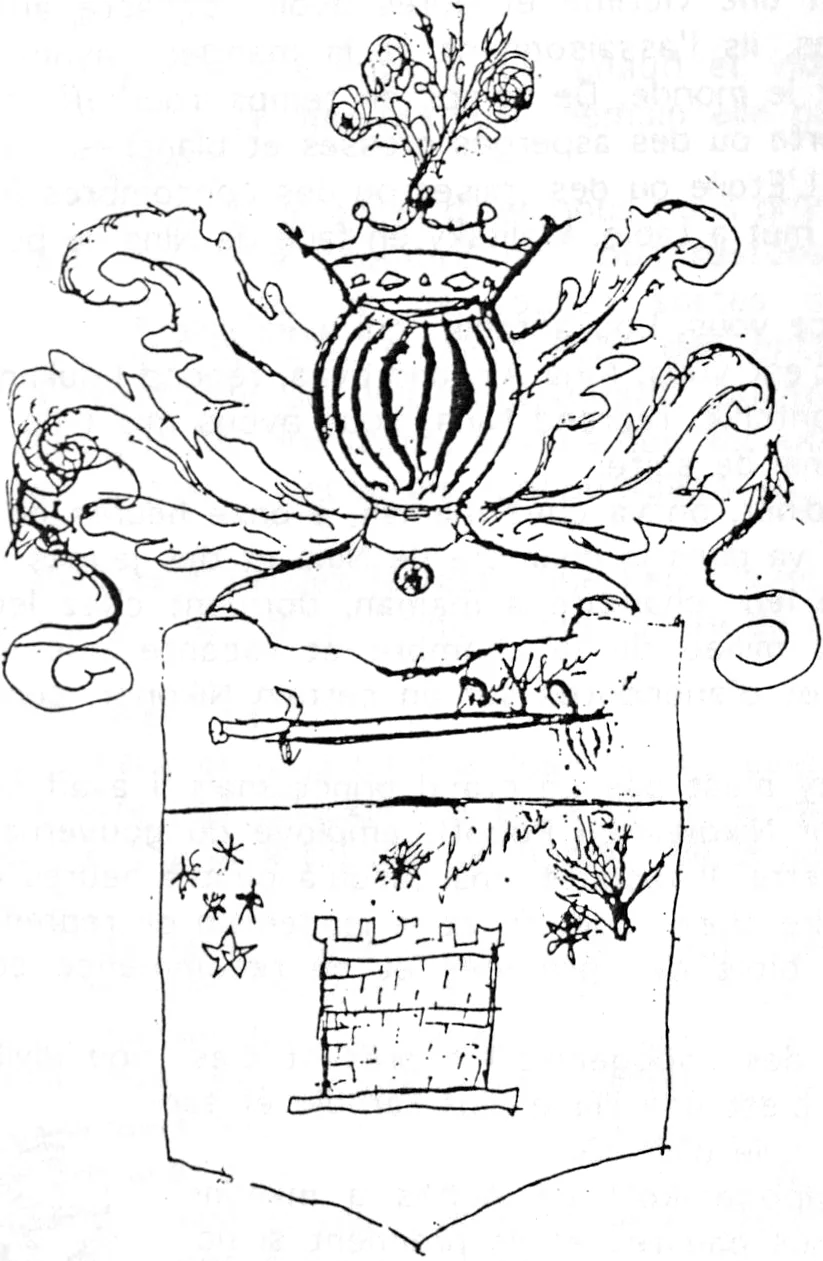
You can see what I have added: I want three roses (the rose is my flower) in place of three feathers, but in place of Ich diene6 I really cannot see what to put. I thought of putting volo7, but that is too presumptuous for a little girl like me, and besides I would rather have a more pious motto — God might be angry. I have added my two dreams, the five stars and the ears of wheat. I really don’t know how to arrange it all. We shall think about it.
On voit ce que j’ai ajouté, je veux avoir trois roses, (la rose est ma fleur), à défaut de trois plumes mais à défaut de Ich diene, je ne vois vraiment quoi mettre, j’ai pensé à mettre volo, mais c’est trop présomptueux pour une petite comme moi et puis j’aime mieux avoir une devise plus pieuse, Dieu pourrait se fâcher. J’ai ajouté mes deux rêves, les cinq étoiles et les épis de blé. Je ne sais vraiment comment disposer tout cela. On y songera.
Detestably dressed, in one of my aunt’s gowns, I go to see La Belle Hélène with Marie, Olga, my aunt and Louba. I keep out of sight, for dressed like this I am not myself.
Détestablement mise, avec une robe de ma tante je vais voir « La Belle Hélène » avec Marie, Olga, ma tante et Louba. Je me cache car je ne suis pas moi-même ainsi mise.
Notes
In English in the original. Blackprince appears to be Marie’s coded nickname for a man she was interested in; the referent is uncertain. ↩
The Bougie de l’Étoile, a well-known Paris brand of stearin candles. ↩
Written in Russian in the manuscript; French translation by the editor. ↩
Written in Russian in the manuscript; French translation by the editor. ↩
Written in Russian in the manuscript; French translation by the editor. ↩
In German in the original, in Marie’s spelling: Ich diene (correctly Ich dien, “I serve”), the motto under the Prince of Wales’s three-feather badge. ↩
Latin: “I will”. ↩