❦
Tuesday, 24 April 1877
I am not sending that last note. I will write him nothing more.Je n’envoie pas ce dernier billet, je ne veux plus rien lui écrire.
I am the most wretched of women. No one can measure the full extent of my degradation! Hideous degradation — I thought myself so far from these horrors, so pure, so...
Je suis la plus misérable des femmes. Personne ne peut mesurer toute l’étendue de mon avilissement ! Avilissement hideux; je me croyais si loin de ces horreurs, si pure, si...
If he believes what he has written, the more I write the more he will believe it — unless... I confess to him that I loved him, which would be, which is impossible.
S’il croit ce qu’il a écrit, plus j’écrirai plus il y croira à moins que... que je lui avoue que je l’aimais, ce qui serait, ce qui est impossible.
I have a fever and am in such a detestable state that I cannot describe it. Carmignano has just left us.
J’ai la fièvre et suis dans un si détestable état que je ne sais le raconter, Carmignano sort de chez nous.
I am going to take a drive outside the city, to get some air and think... my scattered wits are driving me mad.
Je vais faire une promenade hors de la ville pour prendre l’air et songer... mes esprits éparpillés me rendent folle.
I believe — I am certain — that I was right not to send those last letters. The first was enough. To be reduced to making oneself a nuisance to men! That is surely the ultimate degradation, both of the known world and of the world yet to be discovered. The climb up Posillipo,1 with its beautiful views, gave me good food for reflection. To go off somewhere alone and think — that is the best thing to do in such a case. I am disgusted — oh, positively disgusted — with myself and with all the rest of the universe, which means I revolt only in fits and starts. I would find his note crude and infamous, if it were less witty and if it did not prove to me that my letter struck him keenly.
Je crois, je suis sûre que j’ai bien fait de ne pas envoyer ces dernières lettres, la première suffit. Etre réduite à ennuyer les hommes ! Certes voilà le dernier avilissement du monde connu et de celui à découvrir. La montée du Pausilippe me fournissait de bonnes réflexions avec ses beaux points de vue. S’en aller seule quelque part et songer, voilà ce qu’on a de mieux à faire dans ce cas. Je suis dégoûtée, oh ! mais positivement dégoûtée de moi et de tout le reste de l’univers, ce qui fait que je ne me révolte que par bonds. Je trouverais son billet grossier et infâme, s’il était moins spirituel et s’il ne me prouvait pas que ma lettre l’a atteint vivement.
Several people came to inquire after Maman — among others the most celebrated of all the Melissanos — just as I was alighting from my carriage, which I had had closed from the beginning of the Chiaja so as to be less observed alone. One recognised the livery, but one could not see too clearly...
Plusieurs personnes sont venues demander des nouvelles de maman, entre autres le plus célèbre de tous les Melissano au moment où je descendais de ma voiture que j’avais fait fermer dès le commencement de la Chiaja pour être moins vue seule. On reconnaissait la livrée mais on ne voyait pas tellement...
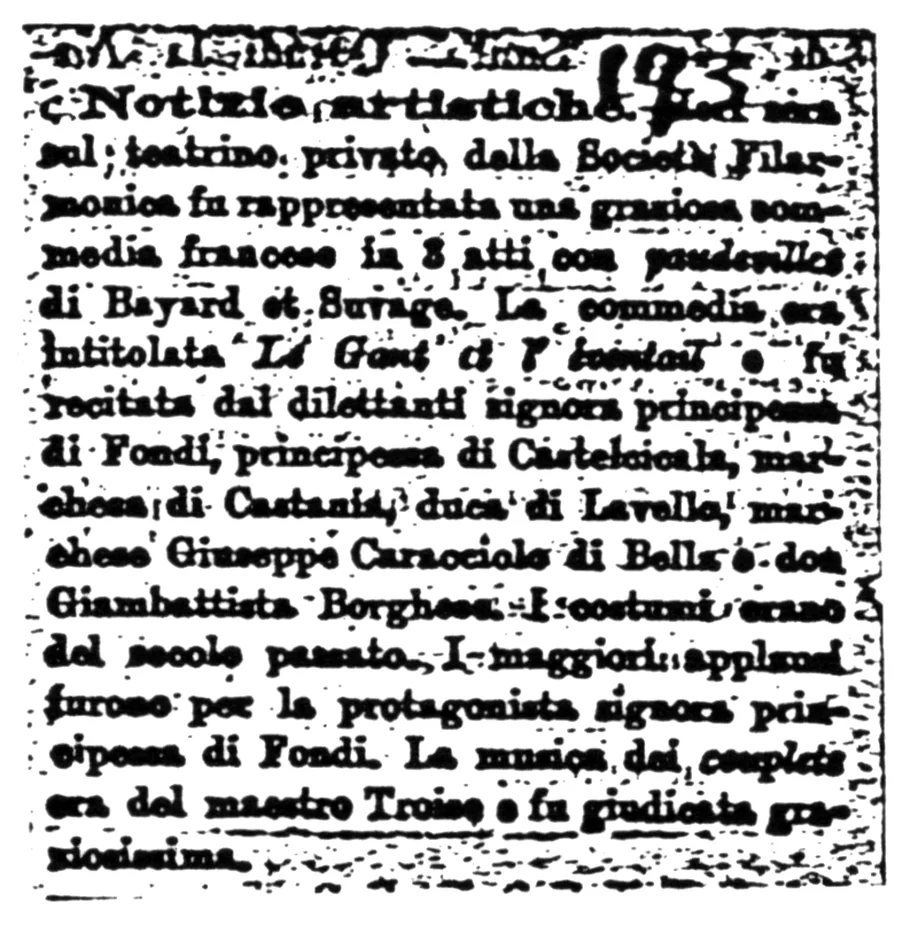
Newspaper clipping · Coupure de journal napolitain (non identifié), «Notizie artistiche», avril 1877Artistic News.2 — Yesterday evening, at the private little theatre of the Società Filarmonica, a charming French comedy in three acts with vaudeville airs by Bayard and Suvage was performed. The comedy was entitled Le Gant et l’éventail,3 and it was acted by the amateurs the Princess di Fondi, the Princess di Castelcicala, the Marchesa di Castania, the Duca di Lavello, the Marchese Giuseppe Caracciolo di Bella and Don Giambattista Borghese. The costumes were of the last century. The warmest applause went to the leading lady, the Princess di Fondi. The music of the couplets was by Maestro Troise and was judged most charming.
Notizie artistiche. — Jeri sera sul teatrino privato della Società Filarmonica fu rappresentata una graziosa commedia francese in 3 atti con vaudevilles di Bayard et Suvage. La commedia era intitolata Le Gant et l’éventail e fu recitata dai dilettanti signora principessa di Fondi, principessa di Castelcicala, marchesa di Castania, duca di Lavello, marchese Giuseppe Caracciolo di Bella e don Giambattista Borghese. I costumi erano del secolo passato. I maggiori applausi furono per la protagonista signora principessa di Fondi. La musica dei couplets era del maestro Troise e fu giudicata graziosissima.
In any case — what was I going to say?
Enfin, qu’est-ce que je voulais dire ?
Ah yes — since Madame is in bed, it is the agreeable Gatowsky who takes us to the Cercle, or rather to the Società Filarmonica,4 where they are performing a French comedy this evening. I wear a very fine white wool gown, fitted in one piece, low-cut with short sleeves. The front of the bodice is entirely covered with green leaves that descend in a single band, crescendo, all the way down and run round the skirt, which is lined with lace and a heap of frothy little nothings that look very pretty. Nothing at the neck, nothing on the arms; Psyche coiffure.5
Ah ! oui, c’est que comme Madame est au lit, c’est le sympathique Gatowsky qui nous emmène au Cercle, ou a la société filarmonica où l’on joue ce soir une comédie française. Je porte une robe de laine blanche très fine, tout d’une pièce et ajustée. Décolletée et manches courtes. Le devant du corsage est tout couvert de feuilles vertes qui descendent en bande unique crescendo jusqu’en bas et font le tour de la jupe doublée de dentelle et d’un tas de petites misères mousseuses qui sont d’un joli effet. Rien au cou, rien aux bras; coiffure Psyché.
For perhaps the first time in Naples I was interesting and pretty — not as before, oh no, but better than of late.
Peut-être pour la première fois à Naples j’ai été intéressante et jolie, pas comme avant, oh ! non, mais mieux que ce dernier temps.
Dina wears a beautiful black gown.
Dina a une belle toilette noire.
The hall is truly brilliant and the lady-actresses have dazzling diamonds.
La salle est vraiment brillante et les dames-actrices ont des diamants éblouissants.
I divided my attention between the very amusing play and our cavaliers! Ah — what a lapse! I forgot to tell you that I had a leaf-fan with a bouquet of lily-of-the-valley attached to the last front leaf.
Je partageais mon attention entre la pièce très amusante et nos cavaliers ! Ah! quel oubli ! J’oubliais de vous dire que j’avais un éventail en feuilles avec un bouquet de muguet attaché sur la dernière feuille-façade.
Bouquet and leaves were immediately dismembered for buttonholes for Pascarola, Campomarino, Caracciolo, and the most Swiss of all, Marcuard — who is mercilessly cold about his passion and is always on the same simple terms with me.
Bouquet et feuilles furent aussitôt démantibulés pour des boutonnières à Pascarola, Campomarino, Carocciolo et le plus Suisse de tous le Marcuard qui est impitoyablement froid pour sa passion et qui est toujours dans les mêmes termes simples avec moi.
The charming thing to report is that Pascarola, after a rather heartfelt little speech on home life, on a little wife, a hearth, a life for two, asked me timidly whether I would come and grace his domestic leisure, serve as his friend, companion, wife — adding that he was sure of obtaining a perfect accord through attentiveness, solicitude, love. Since the proposal was wrapped in philosophical reflections, it was to the latter that I replied — and there the matter rested. It is original.
Ce qu’il y a de joli à dire, c’est que Pascarola après un petit discours assez bien senti sur le chez-soi, sur une petite femme, un foyer, une vie à deux, m’a demandé timidement si je voulais venir charmer ses loisirs domestiques, lui servir d’amie, de compagne, d’épouse, ajoutant qu’il était sûr d’obtenir un parfait accord à force de soins, de prévenances, d’amour. Comme la demande était enveloppée dans des réflexions philosophiques, c’est à ces dernières que j’ai répondu et cela en resta là. C’est original.
I was in a charming humour and joked about Larderel, whom we had the sorrow of losing after having had him every third day, like a fever. I say, laughing, that I adore him, and people repeat it and call him our dear Alexandre without suspecting that... In short, I appear to be making fun of him.
J’étais d’une humeur charmante et plaisantais sur Larderel que nous avons eu la douleur de perdre après l’avoir eu tous les trois jours comme la fièvre. Je dis en riant que je l’adore et on le répète et on l’appelle notre cher Alexandre sans se douter que... Enfin j’ai l’air de me moquer de lui.
We left as soon as the play was over — it would have been melancholy to stay among a set who all know one another; they were waiting for the actors, who were to have supper at the Cercle itself.
Nous sommes parties aussitôt la pièce finie, il aurait été triste de rester au milieu de ce monde qui se connaît, on attendait les acteurs qui devaient souper au Cercle même.
Melito introduces his brother, and just as Campomarino was bringing the cloaks, the Duke of San Cesario came to say a few jests6 which, from a man like him, are almost impertinences.
Melito me présente son frère et au moment ou Campomarino apportait les manteaux, le duc de san Cesario vint dire quelques blagues qui, chez un homme comme lui sont presque des impertinences.
Larderel saw me only when I was plain! That raises a storm. I shall remake myself.
Larderel ne m’a vue que laide ! Cela soulève une tempête. Je me referai.
Let us not do as the imbeciles do — let us not deplore the past, which is beyond remedy.
Ne faisons pas comme les imbéciles, ne déplorons pas le passé qui est sans remède.
I reproach myself with nothing, because it is useless — and I promise myself nothing for the future, for the same reason. One learns how one ought to have acted if the same case arose again, but it is of no use, because nothing repeats itself. It is like people who claim to know women: you may know fifty, but the fifty-first is different. And this is quite natural — so too with men. A few general traits... yes, but the rest! Ah! My emperor7.
Je ne me reproche rien parce que c’est inutile et je ne me promets rien dans l’avenir pour la même raison. On apprend comment il faudrait faire si le même cas se présentait, mais cela ne sert à rien, parce que rien ne se répète. C’est comme les gens qui prétendent connaître les femmes, vous en connaissez cinquante mais la cinquante et unième est différente. Et c’est très naturel, ainsi pour les hommes. Quelques traits généraux... oui, mais le reste ! Ah ! mon empereur.
In the end, the only explanation for... the Aquarium is jealousy.
---
---
Enfin la seule explication de... l’Aquarium c’est la jalousie.
Notes
Posillipo (Pausilippe in the French): a scenic hill overlooking the Bay of Naples, a favourite carriage drive offering panoramic views. ↩
In Italian in the original: a cutting from a Neapolitan paper (Notizie artistiche) pasted into the diary. ↩
Le Gant et l’éventail: “The Glove and the Fan”. ↩
The Società Filarmonica: a private Neapolitan club for music and theatrical performances. ↩
Coiffure Psyché: a classical revival hairstyle with hair gathered up, leaving the neck bare — inspired by ancient Greek sculpture. Fashionable in the 1870s. ↩
In French in the original: blagues — jokes, banter. ↩
In French in the original: Mon empereur — the exclamation Larderel used when tipsy and Marie has adopted. ↩