Jules Massenet
Také známý jako: Massenet, Jules Massenet, M. Massenet
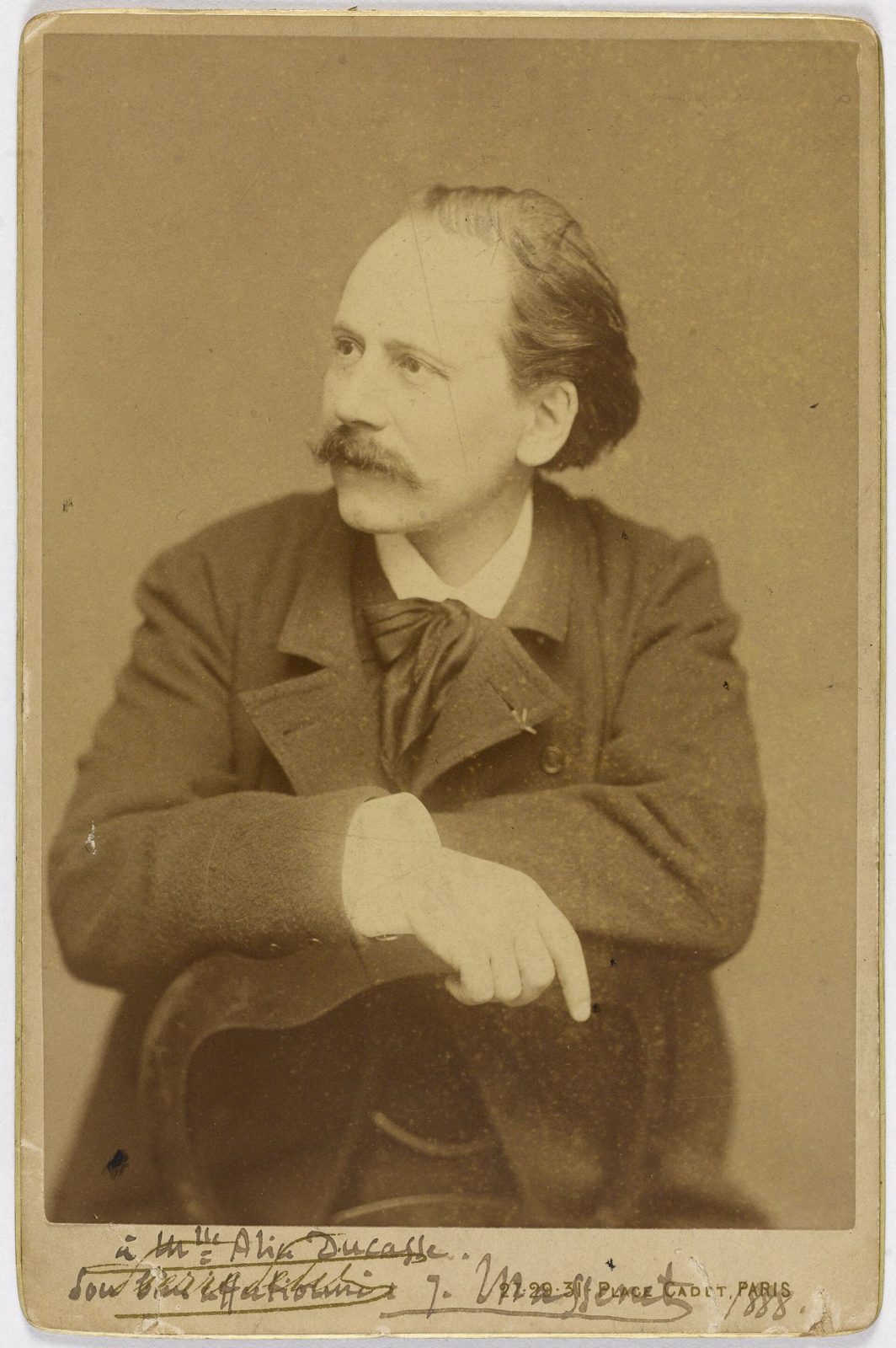
Who he was
Jules Massenet (12 May 1842, Montaud, now part of Saint-Étienne -- 13 August 1912, Paris) was the leading French opera composer of the generation after Gounod. He was elected to the Académie des beaux-arts in 1878 and in the same year became professor of composition at the Paris Conservatoire; he had married Louise-Constance (Ninon) de Gressy in 1866 and their daughter Juliette was born in 1868. His operas up to Marie's death include Don César de Bazan (1872), Le Roi de Lahore (1877), Hérodiade (Brussels, 1881) and Manon (Opéra-Comique, 19 January 1884) (Wikipedia fr, "Jules Massenet"). The Paris premiere of Hérodiade, in Italian at the Théâtre-Italien on 1 February 1884, is the occasion of Marie's longest passage on him (see the BnF and IMSLP listings of the work, e.g. Opera Scotland, Hérodiade).
Marie and Massenet
1879: Le Roi de Lahore
On 9 January 1879 Marie sits with Mme Gavini at the Opéra, cannot listen properly, and imagines Massenet's good moment after the ovation following the third act of "Le Roi de Latore" (that is, Le Roi de Lahore), which she thinks little appreciated and misunderstood at the Opéra; she envies him, "et sa femme ou sa maîtresse" (083.0576--0577). The next day she compares the Bonapartist press's helplessness at the elections with her embarrassment "comme hier pour Massenet quand on a bissé son Incantation et qu'à la seconde fois cela parut moins beau" (083.0580).
1883: a visit to the piano
On 4 April 1883, at a soirée at Mme Lemaire's, "Massenet a joué du piano et de Granier a chanté" (099.0038).
February 1884: Hérodiade
On 3 February 1884 Marie hears Hérodiade at the Théâtre-Italien with the maréchale Canrobert and Claire (103.0254). Her first reaction is rapture: the music "fait corps avec le poème", has no arias or padding, is "large, magnifique, grandiose"; "c'est un grand artiste et désormais une gloire nationale"; "Massenet est un Wagner mélodique français" (103.0264, 103.0273). She compares him with Verdi: "Massenet est français et Verdi italien" (103.0277), and says the composer wants air in an opera and surrounds his characters with a musical atmosphere (103.0290). The next day she retracts: "Je vous demande pardon d'avoir surfait Hérodiade" -- the libretto is weak and Salomé alone with the chorus in the wings recalls Amneris in Aida ("une pâle copie"), the orchestration is full but he abuses it, and the work lacks passion ("Massenet c'est Munkacsy") (103.0291--0294). On 12 February, singing from the score at her organ with a hand in arnica, she finds the melodies "très connus": he has borrowed measures and phrases and, cleverly, even from Offenbach, "et jamais les gens sérieux ne croiront que le savant Massenet de l'institut..." (103.0320--0323). She hears the opera again on 1 March (103.0447). She also reports that the composer is "très gentil", married young, has a fourteen-year-old daughter and a respectable wife, and thinks he should be alone "pour être vraiment grand" (103.0284).
May 1884
On 1 May 1884 at Mme Hochon's, among the Fleurys, Madeleine Lemaire, the Franceschis and the Canroberts, "Massenet a pourtant joué et chanté", and Carolus-Duran sang afterwards (104.0078); this is the last mention.
Related entries
- #Opera -- the Paris Opéra
- #Gavini
- #Canrobert
Sources
- Wikipedia (fr), "Jules Massenet": https://fr.wikipedia.org/wiki/Jules_Massenet
- Production details for the 1884 Paris Hérodiade: https://operascotland.org/opera/139/H%C3%A9rodiade and the BnF/IMSLP listings found in a web search (Théâtre-Italien, 1 February 1884, Italian version).
- Marie Bashkirtseff's diary, paragraphs cited above.
Většina tohoto glosáře vznikla s pomocí jazykových modelů umělé inteligence a byla ověřena podle uvedených zdrojů; chyby jsou možné. Pokud nějakou najdete, nahlaste ji prosím tlačítkem v horní části stránky.