Les trois Rires
Également connu sous : Les trois Rires, Les Trois Rires, trois Rires, The Three Laughs, Три улыбки
Overview
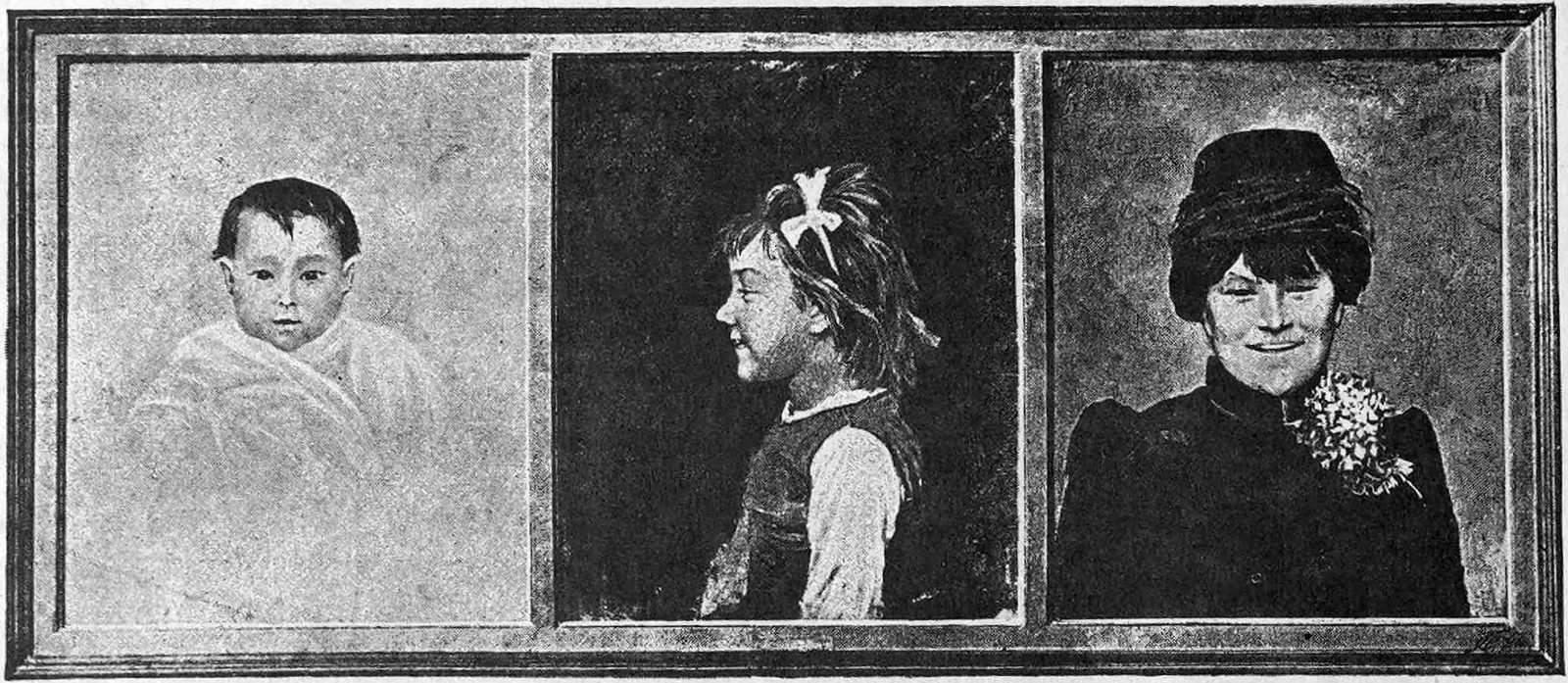
Les trois Rires — "The Three Laughs" — is no. 8 in the posthumous catalogue of February 1885, measured there at 0,55 × 1,45 m: three laughing heads at three ages of a woman's life, framed together. Shown at the Exposition des artistes indépendants shortly after her death, where a critic called it the most accomplished work in the exhibition. Its whereabouts are unknown.
It is the one picture of hers built on an idea rather than a scene — a comic-serious inventory of laughter, made in the last winter of her life by a young woman who had just been told she was consumptive and was going deaf.
Description
The scheme, from the entry of 11 December 1883 (102.0468), was larger than what she made. She had sketched «une tête de gamine de cinq ans, de profil et qui rit» and intended five or six heads, all laughing: a baby of eight months; the five-year-old of that afternoon; Armandine the dancer, seen from the front in a hat and an otter-fur cape with a bunch of violets on her shoulder; a gommeux — a dandy — in the person of Bojidar Karageorgevitch in evening dress, sucking his cane; then an innocent young girl; and finally an old man or an old woman. «Tout ça encadré ensemble», all of it framed together. She closed the passage with the tag she was working from: «Rire est le propre de l'homme» — laughter is what is proper to man, from Rabelais.
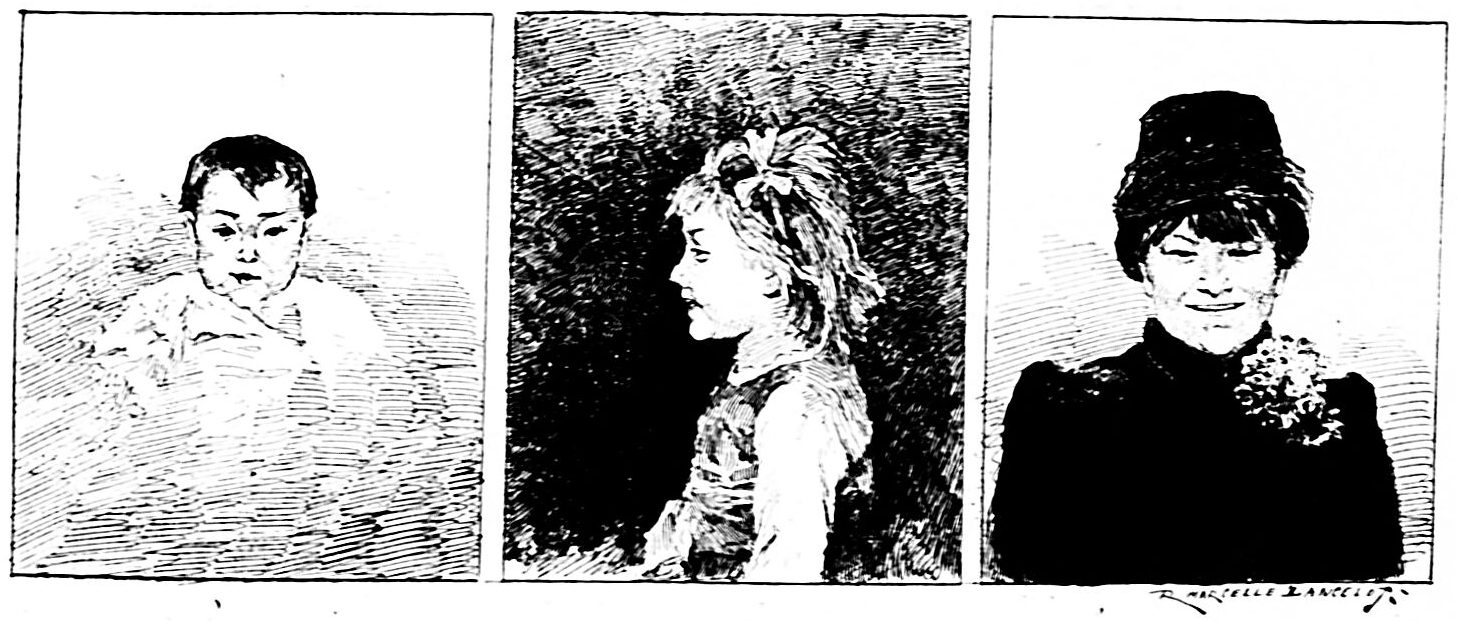
By 1 March 1884, when she lent it to Mme Bertaux's exhibition of the Union des Femmes Peintres et Sculpteurs, it had contracted to three: «trois têtes dans un même cadre. Un bébé qui sourit, une fillette qui rit et Armandine qui éclate de rire» (103.0438) — a baby smiling, a little girl laughing, and Armandine bursting out laughing. The old age and the dandy were dropped; what remains is an ascending scale of a single expression through childhood, girlhood and young womanhood.
Armandine was a dancer at the Eden-Théâtre who posed for her more than once (104.0577–0596), and Marie also made a pastel of her at the end of March 1884 (103.0654) — whether that pastel is the panel's third head or a separate work is not recorded.
Making of the Work
The whereabouts are unknown, and there is a specific lead that does not quite fit. A transcription of the State Russian Museum's wall labels made in 2024 lists «Три улыбки: Улыбка ребёнка / Улыбка девочки / Улыбка девушки» — "Three Smiles: the smile of a child / of a girl / of a young woman" — dated 1883 and measured 55 × 46 cm each, as three separate canvases. Those subjects are exactly the three Marie describes. But the 1885 catalogue records one item of 0,55 × 1,45 m, not three of 55 × 46, and this project does not assert that the Russian Museum's three smiles are Les trois Rires.
It is worth noting, as an observation and not as a finding, that the two records may not actually conflict. Marie's own words are «Tout ça encadré ensemble» — separately painted heads brought together in one frame. Three canvases 46 cm wide, framed side by side with the mouldings between them, come to roughly 145 cm; the heights agree exactly at 55 cm. If the panel was always three canvases in a common frame, a museum cataloguing them individually and a catalogue measuring the frame would describe the same object in incompatible numbers. *Confirming or killing this would need the Russian Museum's inventory, which is not published online and which the museum's Генеральный каталог (vol. 5, 2014) exists in print to settle.*
Two published sources bear on this. The Woman's World (vol. 1, 1888, p. 453) reproduced the picture as three separate canvases set side by side in one long frame, a baby, a girl in profile and a young woman in a hat (shown above). The Russian Museum's own printed catalogues of 1912 and 1917 list «Три улыбки (1883 г.)» among the paintings given by Marie's mother, M. S. Bashkirtseva. Together they support the reading in the paragraph above. They do not show that the picture is in the museum today, so the status here stays "whereabouts unknown".
No photograph of the work has been located. The 1885 catalogue printed a small vignette of the three heads on the page that opens its extracts from the diary (Gallica view 91), shown above. It is the only image of the work known to this project.
References in Diary
- First mention: 1883-12-11 (102.0468) — the whole scheme, five or six laughing heads, and the Rabelais tag
- 1884-03-01 (103.0438) — as actually exhibited: three heads in one frame
- 1884-03-30 (103.0654) — «J'ai fait un pastel d'Armandine»
- 1884-06-09 (104.0577–0596) — Armandine the Eden-Théâtre dancer as a model
Related Entries
- #Jean_et_Jacques and #Un_meeting — the Salon pictures of the same two years
- #Kharkiv_Lost_Works — the losses that make so many of her works untraceable
- #Salon, #Art_Practice
Sources
- Catalogue des œuvres de Mlle Bashkirtseff, Union des Femmes Peintres & Sculpteurs, preface by François Coppée, Paris: Ludovic Baschet, 9 February 1885 — no. 8, 0,55 × 1,45 m. Gallica ark:/12148/bpt6k131932r
- State Russian Museum wall labels, transcribed by a visitor in 2024 — a lead, not a citation; the museum publishes only one Bashkirtseff painting online
- State Russian Museum, Генеральный каталог. Живопись. Т. 5: Вторая половина XIX века (А–И), St Petersburg: Palace Editions, 2014 — print only, not digitised; would settle the question
- The diary, carnets 102–104
- The Woman's World, ed. Oscar Wilde, vol. 1, London: Cassell, 1888, p. 453, «Les Trois Rires», illustrating Mathilde Blind, "Marie Bashkirtseff, the Russian Painter. II" — Internet Archive womans-world-ny_1888_1, leaf n501
- Русский музей императора Александра III. Художественный отдел. Каталог, St Petersburg, 1912, p. 152, and Русский музей, Petrograd, 1917, p. 115: «Три улыбки (1883 г.)», gift of M. S. Bashkirtseva — Internet Archive russkijmuzejimperatoraaleksandraiii89, russkijmuzej94
La plus grande partie de ce glossaire a été établie avec l'aide de modèles de langage (IA) et vérifiée d'après les sources citées ; des erreurs restent possibles. Si vous en repérez une, signalez-la avec le bouton en haut de la page.